

Knife Sharpeners for Kitchen Knives: Buying Guide
The best knife sharpener for kitchen knives depends on how much control you want: a whetstone gives the sharpest, most adjustable result; a pull-through sharpener is the easiest budget choice; a honing rod maintains an already-sharp edge; and an electric sharpener is fastest for frequent, repeatable sharpening. For most home cooks, a medium-grit whetstone or a quality two-stage pull-through sharpener offers the best balance of edge quality, cost, and durability.
| Sharpener type or pick | Best for | Key specifications | Typical market price |
|---|---|---|---|
| King 1000/6000 combination whetstone | Learning traditional sharpening | Water stone; 1000/6000 grit; usually about 7.25 × 2.5 × 1 in | $35–$60 |
| Shapton Pro 1000 | Compact, durable whetstone sharpening | Aluminum-oxide ceramic stone; 1000 grit; about 8.25 × 2.25 × 0.6 in | $45–$70 |
| Work Sharp Precision Adjust | Controlled angles without freehand practice | Adjustable angle system, approximately 15°–30° per side; abrasive plates and ceramic honing surface | $60–$100 |
| Chef’sChoice 4643 | Fast electric sharpening for common kitchen knives | Three-stage electric system; diamond abrasives; designed for conventional and Asian-style edges | $120–$180 |
| Two-stage manual pull-through sharpener | Low-cost, occasional maintenance | Coarse carbide or diamond stage plus ceramic finishing stage; fixed angle, commonly 15° or 20° per side | $15–$50 |
| Fine ceramic honing rod | Maintaining lightly dulled knives | Usually 9–12 in rod length; fine abrasive ceramic; no metal removal control comparable to a stone | $20–$60 |
Best overall: a 1000-grit whetstone
A medium-grit whetstone is the strongest all-purpose choice for someone willing to learn a repeatable technique. A 1000-grit stone can repair ordinary dullness, create a new apex, and sharpen most stainless-steel, carbon-steel, and high-carbon kitchen knives without removing excessive metal. A two-sided 1000/6000 combination stone adds a polishing side, although the finer side is optional for many Western kitchen knives.
Our top picks
 AIERLIAN Knife Sharpener Tool
- 【Accurate and Long-Lasting Sharpness】Any serious chef knows that…
- 【Diamond and Ceramic Discs】AIERLIAN rolling sharpener are equipped…
- 【Multi Angle Magnetic Support】The kitchen knife sharpener always…
 Longzon 5-in-1 Knife Sharpener 4 Stage with
- 4-Stage Precision Sharpening for All Blades: Longzon 4-Stage…
- Enhanced Safety with Cut-Resistant Glove & Non-Slip Base:…
- Sleek, Space-Saving Design for Your Kitchen:Crafted from premium…
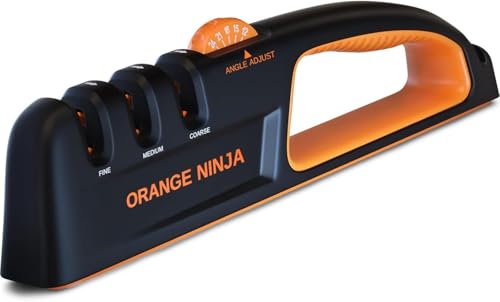 5 Precision Adjust Knife Sharpener- 3-Stage Premium
- Sharpening Simplified: This adjustable angle knife sharpener gives…
- Ease to Use: This handheld knife sharpener system…
- Orange Ninja to Sharp them All: This one…
| Product | Key specs | |
|---|---|---|
| AIERLIAN Knife Sharpener Tool | 【Accurate and Long-Lasting Sharpness】Any serious chef knows that… 【Diamond and Ceramic Discs】AIERLIAN rolling sharpener are equipped… 【Multi Angle Magnetic Support】The kitchen knife sharpener always… | Check price |
| Longzon 5-in-1 Knife Sharpener 4 Stage with | 4-Stage Precision Sharpening for All Blades: Longzon 4-Stage… Enhanced Safety with Cut-Resistant Glove & Non-Slip Base:… Sleek, Space-Saving Design for Your Kitchen:Crafted from premium… | Check price |
| 5 Precision Adjust Knife Sharpener- 3-Stage Premium | Sharpening Simplified: This adjustable angle knife sharpener gives… Ease to Use: This handheld knife sharpener system… Orange Ninja to Sharp them All: This one… | Check price |
 Electric Knife Sharpener for Kitchen Knives | Electric Knife Sharpener Designed for Kitchen Knives Only:Specially… 3-Stage Diamond Grinding System for Precision Sharpening:The 3-stage… 15° Angle Guided Sharpening for Consistent Results:The built-in… | Check price |
As an Amazon Associate we earn from qualifying purchases at no extra cost to you.
King’s 1000/6000 combination stone is a well-known water-stone format, while the Shapton Pro 1000 is a thinner ceramic stone that generally needs less soaking and is convenient in a small kitchen. The important specification is not the brand name but the usable abrasive range: approximately 800–1200 grit for routine sharpening, with a stable base and enough length to accommodate the blade.
The trade-off is a learning curve. You must hold the blade at a consistent angle, use controlled pressure, and flatten the stone when it becomes dished. A whetstone also takes more counter space during use than a pull-through sharpener, and water stones require drying before storage to reduce the risk of cracking or unpleasant odors.
Best budget choice: a two-stage pull-through sharpener
A manual pull-through sharpener is the practical choice for an inexpensive, low-effort solution. The coarse slot restores a neglected edge, while the fine ceramic slot smooths and aligns the newly formed edge. Fixed guides commonly hold the knife at either about 15° per side for many Asian-style knives or about 20° per side for many European and American kitchen knives.
Choose a model with a broad, non-slip base, a securely guarded handle, and separate coarse and fine stages. Some inexpensive sharpeners use carbide cutters that remove metal aggressively. They can make a blunt knife feel sharp quickly, but repeated use may shorten the useful life of a blade and leave a rougher edge than a whetstone or fine ceramic system.
Use a pull-through sharpener only when the knife is compatible with its angle and construction. It is usually unsuitable for single-bevel sashimi knives, serrated blades, very thick blades, flexible fillet knives, and knives with unusually wide bolsters. The main trade-off is limited edge control: you cannot easily choose a different angle, bevel width, or finish.
Best for controlled angles: Work Sharp Precision Adjust
The Work Sharp Precision Adjust suits cooks who want more control than a pull-through system but do not yet trust their freehand technique. Its guided design allows an adjustable sharpening angle, approximately 15°–30° per side depending on the configuration, and uses abrasive plates followed by ceramic finishing surfaces. The guide reduces the chance of accidentally changing the angle halfway through a stroke.
This type of system is useful for expensive chef’s knives, pocket knives, and blades that benefit from a carefully chosen angle. A narrower angle can produce a more slicing-oriented edge on a suitable thin blade, while a wider angle generally gives a more robust edge for chopping and hard use. Follow the knife manufacturer’s guidance rather than assuming the narrowest angle is best.
The trade-off is speed and setup. Guided systems usually require clamping or positioning the knife, and the abrasive area is smaller than a full-size stone. They also contain moving parts and small components that can be misplaced. Clean the guide and abrasives after use, and replace plates when they no longer cut efficiently rather than pressing harder.
Best for speed: a three-stage electric sharpener
An electric sharpener such as the Chef’sChoice 4643 is suitable for households that sharpen several knives regularly and value consistency over maximum customization. Its three-stage design typically combines coarse shaping, finer sharpening, and polishing or stropping. Diamond abrasives are commonly used because they cut hard stainless steels efficiently.
Electric models are particularly convenient when several household knives have become dull at once. They also help users who find it difficult to maintain a steady angle by hand. The motor supplies consistent movement, but the user still controls how many passes are made and how much pressure is applied.
The trade-offs are cost, noise, storage space, and metal removal. An electric sharpener can remove more steel than necessary if you repeatedly run an already-sharp knife through the coarse stage. It may also be incompatible with single-bevel, serrated, unusually thick, or highly curved blades. Per the manufacturer’s instructions, use the stage intended for the knife’s edge style and stop once the edge is restored.
Best for maintenance: a honing rod
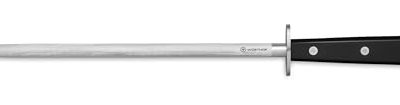
A honing rod is not a complete substitute for a sharpener. It is a maintenance tool that can realign a slightly displaced edge and remove tiny burrs, especially on softer or medium-hard kitchen knives. A steel rod mostly realigns; a ceramic rod removes a small amount of metal and therefore behaves more like a very fine abrasive.
For a typical 8-inch chef’s knife, a 9–12-inch rod gives enough working length without requiring awkward repositioning. Ceramic is often the more useful choice for modern kitchen knives because it provides light abrasion as well as alignment. Diamond-coated rods cut more aggressively and should be used sparingly.
Hold the rod vertically on a stable cutting board, place the heel of the blade near the top, and draw the knife down and toward you while maintaining the intended angle. Repeat on both sides with light pressure. If the knife remains dull after a few gentle passes, switch to a whetstone or other sharpening system; pressing harder with the rod can damage the edge.
How to choose knife sharpeners for kitchen use
1. Match the sharpener to the knife’s edge
First identify whether the knife is double-bevel or single-bevel, and whether its edge is plain or serrated. Most Western chef’s knives, utility knives, and paring knives are double-bevel. Many Japanese knives use a narrower double bevel, while traditional sashimi knives are commonly single-bevel. A standard pull-through device designed for double-bevel knives can ruin a single-bevel profile.
Serrated knives are another exception. Their pointed teeth and recessed gullets usually need a tapered ceramic rod or a sharpener specifically designed for serrations. Do not force the flat side of a chef’s-knife sharpener across a serrated blade.
2. Choose grit based on damage and desired finish
| Condition of the knife | Useful abrasive range | Purpose |
|---|---|---|
| Chipped or severely blunt | Coarse, about 200–500 grit | Repairs damage and establishes a new bevel; use infrequently |
| Ordinary dullness | Medium, about 800–1200 grit | Creates the working edge on most kitchen knives |
| Light refinement | Fine, about 2000–4000 grit | Smooths the edge while retaining useful bite |
| Polishing | 6000 grit and above | Produces a smoother finish; not necessary for most food preparation |
Very polished edges can feel impressively smooth but may lose some aggressive bite on tomato skin, citrus peel, and crusty foods. For a general-purpose kitchen knife, finishing around 1000–3000 grit is often more practical than chasing a mirror polish.
3. Consider the angle and the amount of steel removed
Many European-style kitchen knives work well around 18°–22° per side. Thin Japanese-style knives may use approximately 12°–16° per side, but only if the steel, edge geometry, and intended work support it. Heavy chopping or contact with bones favors a more durable, wider angle.
A useful way to estimate the effect of angle is to compare total included angles. A 20° edge on each side produces a 40° included edge, while a 15° edge on each side produces a 30° included edge. The narrower edge may slice more readily, but it has less material behind the apex and can be more vulnerable to rolling or chipping.
4. Account for frequency, space, and ownership cost
For one or two knives sharpened every few months, a $35–$60 combination stone can be economical. Suppose a stone lasts three years and you sharpen every six weeks: 26 sharpening sessions would put a $45 stone at about $1.73 per session, before counting water and occasional flattening. A $150 electric sharpener used for the same number of sessions costs about $5.77 per session, but its convenience may justify the difference for a busy household.
Store a pull-through or electric sharpener in a dry cupboard and clean away loose metal filings. Let water stones dry completely in a ventilated place, but do not bake them or place them on a radiator. Whetstones wear first in the center where pressure is concentrated; a lapping plate or flattening stone restores a level surface. On pull-through models, abrasive inserts and carbide cutters wear first. On electric units, abrasive wheels and guide surfaces are the main consumables.
A simple sharpening routine that avoids common mistakes
- Clean and inspect the knife. Remove grease and food residue so the blade does not slip. Look for chips, bent tips, and a damaged bolster before selecting the tool.
- Secure the sharpener. Put a stone on a non-slip base or damp towel, or place a pull-through device on a stable surface. Stability matters because a moving sharpener encourages inconsistent angles and increases the chance of injury.
- Start with the least aggressive option. Try a fine ceramic rod or fine stage if the edge is only lightly dull. Move to a 1000-grit stone or coarse stage only when light maintenance no longer restores performance.
- Raise a small burr. On a whetstone, make controlled strokes on one side until you can just feel a fine burr along the opposite side. This confirms that the abrasive has reached the apex rather than merely polished the shoulder of the bevel.
- Repeat on the other side and reduce pressure. Alternate sides, then use lighter finishing strokes to remove the burr. Excessive pressure can flex a thin blade, dig grooves into a stone, or leave a weakened wire edge.
- Rinse, dry, and test safely. Clean away abrasive residue, dry the blade, and test on paper or a soft food such as a tomato. Never test sharpness with a finger.
For example, an ordinarily dull 20°-per-side chef’s knife can be sharpened on a 1000-grit stone with roughly 10–20 controlled strokes per side, followed by lighter alternating strokes. The exact number varies with steel, pressure, and stone wear; the burr and cutting performance matter more than counting strokes.
Frequently Asked Questions
Are whetstones better than pull-through sharpeners?
Whetstones provide better control over angle, bevel width, grit, and metal removal, so they are usually better for knife preservation and customized edges. Pull-through sharpeners are easier and faster for routine household use. The better choice is the one you can use consistently without forcing an incompatible knife through a fixed guide.
Can a honing rod sharpen a completely dull kitchen knife?
Usually not. A honing rod can realign a lightly rolled edge, and a ceramic rod can remove a small amount of metal, but neither is designed to rebuild a badly worn bevel efficiently. Use a medium-grit stone, guided system, or suitable electric sharpener when the knife no longer cuts after light honing.
What grit whetstone should a beginner buy?
A 1000-grit stone is the most useful starting point for ordinary kitchen knives. A combination 1000/3000 or 1000/6000 stone can add refinement, but a very coarse stone is mainly for chips and severe damage. Beginners should prioritize a stable base and a clear angle guide over buying many grits.
How often should kitchen knives be sharpened?
Frequency depends on use, cutting-board material, knife steel, and technique. A home cook may need true sharpening every one to three months, with light honing between sessions. Sharpen when the knife requires extra pressure, crushes rather than slices food, or fails a careful paper test—not according to a rigid calendar.
Which sharpener is safest for an expensive Japanese knife?
A whetstone or an adjustable guided system is generally safer because it can match the knife’s intended angle and bevel. Confirm whether the knife is single-bevel, asymmetric, or unusually thin before sharpening. Avoid generic fixed-angle pull-through devices unless the manufacturer specifically states that the knife is compatible.
When should a sharpening stone be replaced?
Replace or resurface a stone when it is deeply dished, cracked, contaminated, or no longer cuts efficiently after flattening and cleaning. A shallow hollow can often be corrected with a flattening plate. Water stones may wear faster than ceramic stones, but regular flattening and proper drying can extend their useful life.
More from Amazon
Programs that pair well with the guide above. Offers and eligibility are set by Amazon and may change.
Free shipping on eligible items, Prime Video and more. Eligible new members can start with a free trial.
Start a Prime free trialA Prime membership for ages 18-24 with a trial period. Eligibility is set by Amazon.
See Prime for Young AdultsAudiobooks and podcasts to listen to on the go. Eligible new members can start with a free trial.
Try Audible freeAd-free music streaming. Eligible new subscribers can start with a free trial.
Try Music Unlimited freeAs an Amazon Associate we earn from qualifying purchases.
Write Your Review
No reviews yet. Be the first to share your experience!