

Best Manual Knife Sharpeners
The best manual knife sharpener for most cooks is a guided, multi-stage sharpener with a coarse diamond abrasive, a finer ceramic or diamond finishing stage, and an angle guide suited to the knife you use most; for fillet knives, however, a compact diamond rod or guided sharpener with a narrow slot is usually more useful than a fixed-slot kitchen sharpener.
Manual sharpeners are attractive because they are inexpensive, quiet, portable, and simple to operate. Their main limitation is that convenience often comes from removing more metal than necessary. The right choice therefore depends less on the number of stages and more on abrasive material, angle control, compatibility with flexible blades, and how consistently you can repeat the sharpening stroke.
Our top picks
 AccuSharp Knife Sharpener
- This is the perfect knife sharpener for chef’s…
- A sharp blade makes it easier to get…
- AccuSharp sharpening blades are crafted from diamond-honed tungsten…
 Longzon 5-in-1 Knife Sharpener 4 Stage with
- 4-Stage Precision Sharpening for All Blades: Longzon 4-Stage…
- Enhanced Safety with Cut-Resistant Glove & Non-Slip Base:…
- Sleek, Space-Saving Design for Your Kitchen:Crafted from premium…
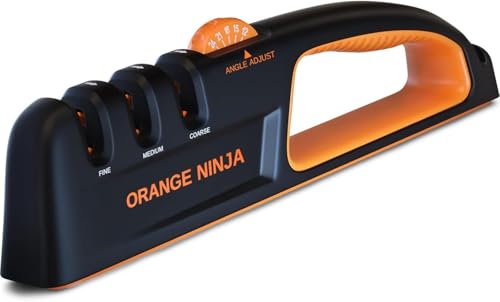 5 Precision Adjust Knife Sharpener- 3-Stage Premium
- Sharpening Simplified: This adjustable angle knife sharpener gives…
- Ease to Use: This handheld knife sharpener system…
- Orange Ninja to Sharp them All: This one…
| Product | Key specs | |
|---|---|---|
| AccuSharp Knife Sharpener | This is the perfect knife sharpener for chef’s… A sharp blade makes it easier to get… AccuSharp sharpening blades are crafted from diamond-honed tungsten… | Check price |
| Longzon 5-in-1 Knife Sharpener 4 Stage with | 4-Stage Precision Sharpening for All Blades: Longzon 4-Stage… Enhanced Safety with Cut-Resistant Glove & Non-Slip Base:… Sleek, Space-Saving Design for Your Kitchen:Crafted from premium… | Check price |
| 5 Precision Adjust Knife Sharpener- 3-Stage Premium | Sharpening Simplified: This adjustable angle knife sharpener gives… Ease to Use: This handheld knife sharpener system… Orange Ninja to Sharp them All: This one… | Check price |
 Henckels Handheld Knife Sharpener | 2-stage sharpener labeled for ease use Coarse and fine ceramic grits yield razor-sharp knives Easy-to-hold handle is contoured for comfort | Check price |
As an Amazon Associate we earn from qualifying purchases at no extra cost to you.
Quick comparison of the main types
| Sharpener type | Typical abrasive | Typical edge angle | Best use | Main limitation |
|---|---|---|---|---|
| Pull-through carbide | Carbide or tungsten carbide | 20–25° per side | Fast repair of inexpensive, blunt kitchen knives | Removes substantial metal and offers limited control |
| Pull-through diamond | Diamond-coated plates or rods | 15–22° per side | Harder steels and routine kitchen sharpening | Diamond surfaces wear if excessive pressure is used |
| Multi-stage manual sharpener | Coarse diamond, fine diamond, ceramic or honing material | Usually 15–20° per side | General kitchen and utility knives | Fixed slots may not suit thick or flexible blades |
| Guided rod system | Ceramic, diamond or coated steel rods | About 15–25° per side | Repeatable sharpening and different knife profiles | Slower learning curve and more storage space |
| Diamond sharpening rod | Diamond-coated steel | Set by the user | Fillet knives, serrations and field maintenance | Requires more skill to keep the angle consistent |
Our picks by situation
Best all-round choice: a two- or three-stage guided pull-through sharpener
For a household that sharpens chef’s knives, utility knives and boning knives every few weeks, choose a stable manual sharpener with separate coarse and fine stages. The coarse stage should be diamond rather than an aggressive carbide insert whenever possible. Diamond cuts efficiently on harder stainless steels, while the fine ceramic stage can refine the edge without removing as much material.
Look for a base at least 100 mm long, a non-slip underside, and a handle that lets your knuckles remain clear of the blade. A 15° setting suits many thinner Japanese-style kitchen knives; an 18° to 20° setting is a more forgiving choice for general Western kitchen knives. A selector that changes the angle is useful only if it locks securely and the slots are clearly labelled.
Best for fillet knives: a narrow diamond rod or flexible-blade-compatible guided sharpener
Fillet knives are difficult for fixed-slot sharpeners. Their blades are thin, often narrow near the tip, and designed to flex. A broad V-slot can fail to contact the edge evenly, while a rigid angle guide may force the blade into a position that does not match its geometry.
A fine diamond rod around 100–150 mm long and approximately 3–6 mm in diameter is a practical choice for many fillet knives. Use light pressure and follow the existing bevel rather than forcing a nominal angle. A rod with a fine ceramic section is preferable when you are maintaining an already sharp blade. For very thin fillet knives, a sharpener that specifically states compatibility with flexible or narrow blades is safer than a generic two-slot unit.
Best for occasional emergency sharpening: a compact carbide or ceramic pull-through
If a knife is used only occasionally and the priority is speed, a compact pull-through sharpener can restore a serviceable edge in a few passes. This is the budget option, not the precision option. Carbide inserts are particularly aggressive and can create a rough, uneven bevel if you press down hard or pull the blade too quickly.
Use this style for robust, inexpensive knives rather than thin fillet knives, high-hardness Japanese knives, or blades with a single-sided bevel. A ceramic finishing slot makes the result less coarse, but it does not correct poor angle compatibility.
Best for control: a guided rod system
Guided rod systems take longer to set up but produce more repeatable results than a freehand rod. They are useful when you own several knives with different bevels or want to preserve a particular edge angle. Some systems use ceramic rods for maintenance; others use diamond rods for reshaping and ceramic rods for finishing.
The trade-off is space and technique. The knife must be held steadily, the rod must be kept fully seated in its guide, and the blade should be moved through the abrasive in controlled sections. A guided system is often a better long-term purchase than replacing a succession of inexpensive pull-through sharpeners.
Abrasive materials: what the difference means
- Diamond: the most versatile choice for modern stainless and harder steels. It cuts quickly, so use light pressure. Coarse diamond is for a damaged or very dull edge; fine diamond is for routine refinement.
- Ceramic: a good finishing and maintenance material. It removes less metal than coarse diamond or carbide and is well suited to knives that are slightly dull rather than damaged.
- Carbide: fast and inexpensive, but comparatively aggressive. It can leave a serviceable edge on a working knife while shortening the knife’s useful life if used too often.
- Honing steel: primarily realigns a rolled edge rather than grinding a new bevel. It is not a substitute for an abrasive sharpener when the edge is genuinely dull.
Do not judge quality by grit numbers alone. Manual sharpeners often do not publish comparable grit standards, and a diamond surface, ceramic rod and abrasive belt with the same nominal number can behave differently. The abrasive’s shape, pressure and fixed angle affect the result just as much.
Angle choice and knife compatibility
| Knife | Useful starting angle per side | Preferred sharpener characteristics |
|---|---|---|
| Thin Japanese kitchen knife | 12–17° | Fine diamond or ceramic; adjustable guide; avoid aggressive carbide |
| General Western chef’s knife | 18–22° | Stable two-stage sharpener with a clearly defined guide |
| Boning or utility knife | 18–22° | Diamond stage and enough slot clearance for a thicker spine |
| Flexible fillet knife | About 15–20°, following the existing bevel | Narrow fine diamond rod or flexible-blade-compatible guide |
| Single-bevel knife | Follow the manufacturer’s bevel | Flat abrasive or specialised single-bevel method, not a standard V-slot |
The quoted angle may mean the angle on each side or the total included angle. Confirm this before buying. A “20-degree sharpener” commonly means approximately 20° per side, producing a 40° included edge, but manufacturers are not perfectly consistent in their wording.
How to get consistent results
- Clean and inspect the blade. Remove grease and check whether the edge is chipped, bent or simply dull. A damaged edge may need a coarse stage; a merely tired edge usually does not.
- Secure the sharpener. Place it on a dry, stable surface. If it moves during the pull, the angle changes and the edge can become uneven.
- Use the least aggressive stage first. Try the fine ceramic or fine diamond stage. Move to coarse abrasive only when the fine stage cannot restore bite.
- Make slow, light passes. Pull the knife from heel to tip without sawing back and forth. Follow the manufacturer’s direction; many pull-through sharpeners are designed for one-way pulls.
- Sharpen both sides evenly. Use the same number of passes unless the knife has a deliberately asymmetric bevel.
- Check for a burr. A small, continuous burr along the opposite side indicates that the abrasive has reached the edge. Remove it with a few light finishing passes rather than applying more force.
- Wash and dry the knife. Wipe away metal particles before the knife returns to food preparation.
As a practical starting point, try three to five light passes in the fine stage, then test the edge on paper or a tomato skin. If it remains dull, use the coarse stage for two or three passes per side and return to the fine stage. The exact number is less important than avoiding unnecessary grinding.
Durability and ownership costs
The first parts to wear are usually the abrasive surfaces, not the handle. Diamond coatings gradually become less aggressive; ceramic rods accumulate metal residue; carbide inserts can chip if a blade is forced sideways through the slot. A sharpener used twice a month may last for years, while one used on a busy fish-cleaning bench can show noticeable wear much sooner.
For a simple calculation, suppose a $25 manual sharpener remains effective for 250 sharpening sessions. Its abrasive cost is about 10 cents per session, before considering the value of the knives it preserves. A $60 guided system lasting 600 sessions works out at the same approximate rate, while offering more angle control. The cheaper purchase is not automatically cheaper ownership if it removes excessive metal or encourages early knife replacement.
Clean diamond and ceramic surfaces according to the manufacturer’s instructions. Many should be wiped with a dry or slightly damp cloth rather than soaked. Never use cooking oil on an abrasive slot unless the instructions specifically permit it, and do not put a manual sharpener in a dishwasher. Replace a unit when its guides loosen, its base slips, or it produces a noticeably asymmetric edge after careful use.
Final buying advice
Choose a multi-stage diamond-and-ceramic sharpener with a stable base for ordinary kitchen knives. Choose a fine diamond rod or a guide designed for flexible blades when fillet knives are the priority. Choose carbide only when speed and low purchase cost matter more than maximum edge life. For several knife types and a long-term interest in sharpening, a guided rod system offers the best balance of control and repeatability.
The most important specification is not the number of slots. It is whether the abrasive and angle match your knives, whether the sharpener stays still, and whether it lets you use light, repeatable strokes.
More from Amazon
Programs that pair well with the guide above. Offers and eligibility are set by Amazon and may change.
Free shipping on eligible items, Prime Video and more. Eligible new members can start with a free trial.
Start a Prime free trialA Prime membership for ages 18-24 with a trial period. Eligibility is set by Amazon.
See Prime for Young AdultsAudiobooks and podcasts to listen to on the go. Eligible new members can start with a free trial.
Try Audible freeAd-free music streaming. Eligible new subscribers can start with a free trial.
Try Music Unlimited freeAs an Amazon Associate we earn from qualifying purchases.
Write Your Review
No reviews yet. Be the first to share your experience!