

The Yoshihiro 16-layer hammered Damascus VG-10 six-piece set suits a home cook who wants one coordinated block-free collection with a long slicer, a vegetable knife and a small utility blade, while the two-piece gyuto and paring set suits someone who only needs a main knife and a small knife. Buyers who dislike hand-washing, or who want a knife they can ignore between uses, will be happier with a different steel and a simpler finish. The rest of this guide explains what the VG-10 label means, what the Yoshihiro listings actually state, and where the trade-offs sit.
Our top picks

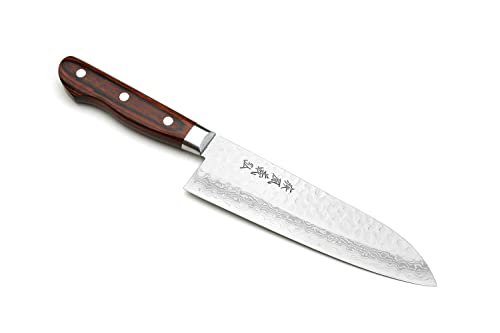
 Yoshihiro 46 Layers Hammered Damascus Gyuto Chef
- Forged and hammered with 46 layers of steel…
- The most versatile and essential of all knives…
- Sometimes called a utility knife, the Petty is…

As an Amazon Associate we earn from qualifying purchases at no extra cost to you.
What VG-10 Steel Means for a Home Cook
VG-10 is a stainless steel developed in Japan for cutlery. Makers who use it generally describe it as a hard, fine-grained stainless that can take a keen edge and hold it for a good while without the rust worries of plain carbon steel. In the Yoshihiro lines, the VG-10 sits in the middle of the blade as a core, and softer outer layers are forged around it to create the rippled, layered look called Damascus. The layers are visual and protective: the cutting edge itself is the VG-10 core.
The product listings for the 16-layer hammered series state a hardness of 60 HRC. That is a firm blade by Western standards, where many mass-market kitchen knives are softer. Hard steel tends to keep an edge longer, but it can also be less forgiving. A twisting motion through a squash, a rolling knock against a bone, or a drop onto tile can chip a hard edge in a way a softer German-style blade would simply bend and survive. That is the central trade-off to understand before buying any VG-10 set.
One discussion thread among cooks, where a beginner worried about damaging a VG-10 knife while sharpening it, describes the steel as not easy to sharpen but certainly not impossible. That matches the general picture: you need a decent whetstone or a sharpening service, a steady angle, and patience. If you have never sharpened a knife, factor that into your decision, or plan to pay a professional occasionally.
The Yoshihiro Sets at a Glance
The table below summarizes the configurations that appear in listings for the series. Details come from the product pages and listings for the Yoshihiro line; piece counts and sizes are as the listings state them, and a given seller may bundle slightly different extras.
| Set | Contents (as listed) | Best for | Stated build | Limits |
|---|---|---|---|---|
| 16-layer hammered Damascus, six-piece | Two gyuto (about 8.25 and 9.5 inch), petty, sujihiki, santoku, nakiri | Cooks who want a full Japanese-style lineup in one purchase | VG-10 core, 16 layers, 60 HRC, mahogany Western-style handle, made in Japan | Largest outlay; two gyuto overlap; storage space needed |
| 16-layer hammered Damascus, gyuto and paring | Gyuto chef knife and a small paring knife | Small kitchens and first Japanese knives | Same series construction, 60 HRC | No slicer or vegetable cleaver; paring knife is short |
| 16-layer hammered Damascus, gyuto and petty | Gyuto plus a petty utility knife | Everyday prep with one longer and one shorter blade | Same series construction | Petty is not a replacement for a dedicated paring knife for peeling in hand |
| 46-layer hammered Damascus, single gyuto | One 9.5 inch gyuto, octagonal rosewood handle | Buyers who want a showpiece main knife rather than a set | VG-10, 46 layers, octagonal rosewood handle | Single knife, not a set; handle shape is a Japanese-style octagon some Western grips dislike |
The older review coverage of the six-piece set describes the contents as a 240 mm gyuto, a 210 mm gyuto, a petty and a sujihiki, with mahogany handles, which differs slightly from listings that add a santoku and a nakiri. This is a reminder that bundles change over time, and it is worth reading the exact piece list on whichever page you buy from.
Knife Types Explained
Gyuto
The gyuto is the Japanese interpretation of a chef knife. It has a long, relatively thin blade and a gentle curve for rocking. The 8.25 inch size is comfortable on a small board, and the 9.5 inch size is better for large produce and roasts. Most home cooks do not need both, which is why the six-piece set has a built-in overlap.
Petty and Paring
A petty is a mid-length utility knife, usually longer than a paring knife. It works for shallots, citrus, trimming and anything where a full gyuto feels clumsy. A paring knife is shorter and suits peeling or hand-held work. Pick the paring set if you peel fruit in your palm; pick the petty set if you mostly work on a board.
Sujihiki
The sujihiki is a long slicer with a narrow blade, designed for carving cooked meat and portioning fish in clean strokes. If you roast joints, trim fillets or slice cured fish, it earns its place. If you rarely carve, it will spend most of its life in a drawer.
Santoku and Nakiri
The santoku is a compact all-purpose knife with a flatter edge. The nakiri is a rectangular vegetable knife for straight up-and-down chopping. Both favor push-cutting over rocking, which suits people who cut large quantities of vegetables.
Fit, Handle and Care Notes
The series uses a Western-style mahogany handle in the set listings, which tends to feel familiar for people moving over from German or American knives. The single 46-layer gyuto instead lists an octagonal rosewood handle, a Japanese-style shape. Octagonal handles are often praised for orientation by feel and criticized by some cooks for hot spots in a pinch grip, so hold one if you can before committing.
Care guidance for the line is straightforward: hand wash and dry promptly. Dishwashers expose thin hard edges to knocks, hot water and harsh detergent, all of which dull or damage them. Use a wood or soft synthetic board, never glass, stone or ceramic. Avoid cutting through bones, frozen food or hard shells with any VG-10 blade. A honing steel is not the right tool for very hard steel in many cases, so a fine whetstone or ceramic rod, used gently, is a better routine. Follow the maker’s care instructions that come with the knives.
Finally, store the knives in a block, magnetic strip or sheath rather than loose in a drawer. The listings mention that some knives ship with a cover; use it if so.
Reading the Reviews with Caution
The volume of Yoshihiro coverage online is large, but much of it is promotional. A late 2025 blog review praises the gyuto for balance, edge retention and its pattern, yet reads more like marketing copy than critical analysis. Customer comments on the 46-layer gyuto are positive but sparse, with sharpness and appearance the main themes. Independent, critical tests of full Yoshihiro sets are hard to find, so treat enthusiastic claims as indications rather than measurements. The hardness figure, the construction and the piece lists are the most reliable details because they come from product listings rather than opinion.
Budget Tiers
- Budget: A two-piece gyuto and paring set is the entry point. It covers most daily tasks and lets you learn how a hard Japanese edge behaves before spending more.
- Mid-range: The gyuto and petty set or the single 46-layer gyuto sits here. The single knife suits cooks who will use one blade for 90 percent of tasks.
- Premium: The six-piece set is the premium option within this brand. It makes sense only if you will actually use the slicer and vegetable knives.
Pick X If …
| Pick this | If you … |
|---|---|
| Six-piece set | want a complete matched collection, carve meat or fish, and are comfortable with hand-washing and occasional sharpening |
| Gyuto and paring set | cook for one or two, have limited drawer space, and want a first Japanese knife pair |
| Gyuto and petty set | work mostly on a board and prefer a longer small knife to a short paring blade |
| Single 46-layer gyuto | want one standout knife and are fine adding other knives later |
| A different brand or steel | want something dishwasher tolerant, drop tolerant or low maintenance |
Alternatives to Consider
- Other VG-10 lines from Japanese makers: Several established brands sell VG-10 chef knives and small sets with plain finishes. A plain finish costs less than hammered Damascus because the layered look adds production steps, and it performs the same where it counts, at the edge.
- Softer German-style stainless sets: Knives in this tradition generally use softer steel that is easier to hone and tolerates rough handling. They need more frequent honing but are forgiving.
- A single good chef knife plus a budget paring knife: Many cooks get more value from one well-chosen knife and one cheap small knife than from a large set with pieces they seldom use.
Mistakes to Avoid
- Do not assume more layers means a better cutting edge. The edge is the core steel; layers affect looks and the outer cladding.
- Do not buy a six-piece set for the sake of the number. Count the tasks you actually do.
- Do not use the knives on bones, frozen items or glass boards.
- Do not leave them wet in a sink or soaking.
- Do not expect a hard knife to behave like a soft one; use a smooth push or slice rather than twisting or prying.
Frequently Asked Questions
Is VG-10 a good steel for a home kitchen?
Makers and reviewers generally describe VG-10 as a hard stainless steel that holds an edge well and resists rust. Its hardness also means it can chip if misused, so it rewards careful handling. For a home cook who hand-washes and uses a proper board, it is a common and well-regarded choice.
What does 60 HRC mean?
HRC refers to the Rockwell hardness scale. The listings for the 16-layer hammered series state 60 HRC, which is firm and typical of Japanese kitchen knives. Higher numbers usually mean better edge retention but more brittleness.
Are the Damascus layers functional?
The layers are forged around the VG-10 core and give the blade its rippled appearance. They also form protective cladding, but the cutting edge is the core steel. Choose by core steel, hardness and shape rather than layer count.
Can these knives go in the dishwasher?
The care guidance associated with the line is hand washing, and that is the safer approach for any thin, hard blade. Dishwashers can knock edges against other items and expose handles to heat and detergent, which can cause damage over time.
How do I sharpen a VG-10 knife?
Most cooks use a whetstone at a consistent angle, starting with a medium grit and finishing with a fine one. Some cooks describe VG-10 as not easy to sharpen but entirely doable. If you are unsure, a professional sharpening service is a reasonable option while you learn.
Do I need both a gyuto and a santoku?
Not usually. Both are general-purpose knives, and most cooks find one covers the work of the other. Choose the gyuto if you like rocking cuts and the santoku if you prefer a shorter, flatter push cut.
More from Amazon
Programs that pair well with the guide above. Offers and eligibility are set by Amazon and may change.
Free shipping on eligible items, Prime Video and more. Eligible new members can start with a free trial.
Start a Prime free trialA Prime membership for ages 18-24 with a trial period. Eligibility is set by Amazon.
See Prime for Young AdultsAudiobooks and podcasts to listen to on the go. Eligible new members can start with a free trial.
Try Audible freeAd-free music streaming. Eligible new subscribers can start with a free trial.
Try Music Unlimited freeAs an Amazon Associate we earn from qualifying purchases.










Write Your Review
No reviews yet. Be the first to share your experience!