

The best RC boats depend on where you will run them: a self-righting, sealed pool boat is the safest choice for beginners, a compact jet-drive model suits small lakes, and a deep-V brushless boat is the better pick for fast racing on open, calm water.
Our top picks
 BEZGAR TX123 Remote Control Boats
- Hobby RC Boat for Pools & Lakes -…
- Fearless of Capsizing - Tumbler design with a…
- Portable-to-take RC Boat Suitcase - Our remote control…
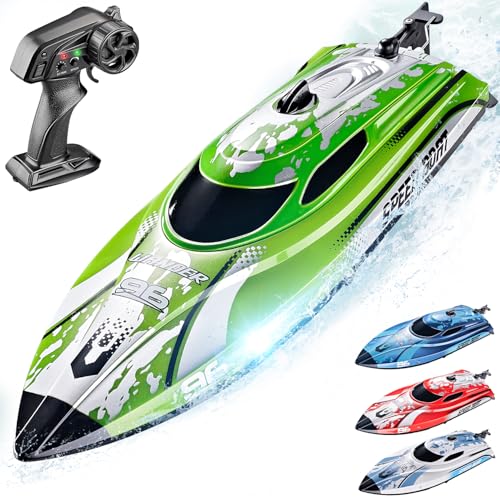 BEZGAR RC Boat TX126-12 Inch Remote Control
- Experience the thrill of fast rc boats with…
- Enjoy 400 ft long-distance warning feature on this…
- Dive into excitement with the double layers waterproof…
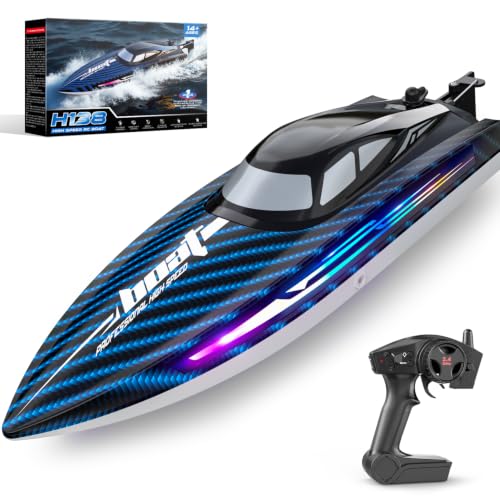 30KMH RC Remote Control Boat with 7
- Fast and Far Range: The max speed of…
- Worry-Free Play with One Key Self-righting and Waterproof…
- Low Battery/Over Distance/Signal Interference Alert: The control will…
| Product | Key specs | |
|---|---|---|
| BEZGAR TX123 Remote Control Boats | Hobby RC Boat for Pools & Lakes -… Fearless of Capsizing - Tumbler design with a… Portable-to-take RC Boat Suitcase - Our remote control… | Check price |
| BEZGAR RC Boat TX126-12 Inch Remote Control | Experience the thrill of fast rc boats with… Enjoy 400 ft long-distance warning feature on this… Dive into excitement with the double layers waterproof… | Check price |
| 30KMH RC Remote Control Boat with 7 | Fast and Far Range: The max speed of… Worry-Free Play with One Key Self-righting and Waterproof… Low Battery/Over Distance/Signal Interference Alert: The control will… | Check price |
 BEZGAR HJ818PRO 16 Inch 55 KPH Brushless | Experience the thrill of big fast rc boats… Enjoy 656 ft long distance warning feature on… Dive into excitement with upgraded waterproof cabin and… | Check price |
As an Amazon Associate we earn from qualifying purchases at no extra cost to you.
Quick picks by water and experience
| Use case | Best boat type | Useful target specifications | Why it fits |
|---|---|---|---|
| Swimming pool or small pond | Brushed propeller or water-jet boat | 30–45 cm long, 15–25 km/h, 2S battery, 10–15 minute runtime | Easy to control and less likely to hit dangerous speed before reaching the opposite bank |
| Calm recreational lake | Self-righting deep-V or mono-hull | 45–65 cm long, 25–45 km/h, 2S or 3S LiPo, 12–20 minute runtime | Balances stability, range, and manageable operating cost |
| Fast racing | Brushless deep-V or catamaran | 55–85 cm long, 50–80+ km/h, 3S or 4S LiPo, 5–10 minute runtime | Sharp acceleration and efficient planing, but requires open water and experience |
| Weedy or debris-filled water | Water-jet boat or protected propeller design | 30–60 cm long, removable intake grate, 2S battery, 15–25 km/h | Less exposed running gear than a conventional exposed propeller |
Best RC boats for lakes, pools, and racing
Best for beginners: a small self-righting brushed boat
A compact self-righting boat is the most forgiving starting point. Brushed motors are slower than brushless systems, but they draw less power, cost less to replace, and are easier to pair with inexpensive batteries and chargers. Look for a 30–45 cm mono-hull with a 2.4 GHz radio, low-battery warning, water-cooled motor, and automatic righting.
Self-righting matters because a small boat can flip after a sharp turn or wake impact. The function usually reverses the motor briefly or changes propeller thrust to roll the hull upright. It is not a substitute for a rescue plan: repeated righting attempts can drain the battery quickly, and some designs cannot recover if they stop upside down in very calm water.
This class works in a large pool, sheltered pond, or calm lake. Avoid tall grass, floating branches, and strong wind. A small hull has little momentum and can be pushed into the bank before you have time to turn it.
Best for general lake use: a self-righting brushless deep-V
For regular lake boating, a medium brushless deep-V offers the best balance of speed and stability. Models such as the Pro Boat Recoil 2 18-inch self-righting boat represent this category: a relatively compact hull, brushless power, water cooling, and recovery assistance. Specifications vary by version and package, so check whether the advertised speed and battery are included rather than assuming they are.
The deep-V hull cuts through small ripples more cleanly than a flat-bottom boat and is less likely to slap sideways when turning. It still needs reasonably calm water. A 45–60 cm boat can handle light chop, but wind-generated waves that approach one-quarter of the hull length can make the boat difficult to control and may allow water into the canopy.
Choose 2S power for longer, calmer sessions and lower stress on the drivetrain. A 3S setup delivers stronger acceleration and higher speed, but it also increases heat, propeller damage, battery cost, and the chance of a hard crash.
Best for speed: a brushless catamaran or large deep-V
Fast racing boats use brushless motors, high-current electronic speed controls, and LiPo batteries. Traxxas models such as the Spartan and DCB M41 are examples of larger performance boats, while the Pro Boat Blackjack range illustrates the compact catamaran format. These boats are designed to get on plane quickly and maintain speed with less wetted hull area.
A catamaran can be very fast in a straight line and stable at speed, but it may react abruptly to crosswinds or a poorly timed turn. A deep-V is generally more predictable in moving water, though it may roll more during a tight turn. For a first performance boat, a self-righting deep-V is usually easier to recover than a racing catamaran.
Fast boats need a wide, empty operating area. Do not use one in a crowded swimming area, near fishing lines, around wildlife, or where the far bank is closer than the boat’s stopping distance. At 60 km/h, a boat travels about 17 metres every second, so a long advertised radio range does not make a small pond suitable.
Hull design: the difference you feel on the water
- Mono-hull: A practical all-round shape. It turns predictably and is usually easier to launch, transport, and repair.
- Deep-V: The best compromise for lake chop. The V-shaped bottom softens impacts, but the boat can lean in turns and may require careful throttle control.
- Catamaran: Efficient and fast in calm water. It can run straight at high speed, but wind and uneven weight distribution can make it unpredictable.
- Flat-bottom hull: Stable at low speed and useful in pools, but it tends to bounce or slap in waves.
- Jet-drive hull: The enclosed impeller is safer around shallow water and vegetation than an exposed propeller, although weeds can still block the intake and jet boats are often less efficient.
Battery runtime, range, and the numbers that matter
Manufacturers commonly quote maximum runtime under gentle conditions. Fast planing uses substantially more power. A realistic session for a brushless boat is often 6–12 minutes at frequent full throttle, or 12–20 minutes with mixed-speed driving. Brushed boats may provide similar or longer runtime because their motors demand less current.
A simple estimate helps compare batteries. If a boat uses a 2S 5,000 mAh battery, its nominal energy is approximately:
7.4 volts × 5 amp-hours = 37 watt-hours.
If the average electrical draw while driving is 180 watts, the theoretical runtime is 37 ÷ 180, or about 12 minutes. Because LiPo batteries should not normally be run completely flat and acceleration is uneven, a practical figure may be closer to 8–10 minutes. A 3S 5,000 mAh pack contains about 55.5 watt-hours, but the higher voltage can raise speed and current demand, so it does not automatically provide 50 percent more driving time.
Radio range is also conditional. A quality 2.4 GHz system may advertise several hundred metres, but trees, low antennas, spray, terrain, and a small boat disappearing behind a wave reduce the usable distance. Operate well inside the visible range and keep the transmitter antenna clear of your body and metal objects.
Waterproofing: what it protects and what it does not
“Waterproof” normally means the receiver box, motor, and speed controller are protected against splashes when the canopy is correctly fitted. It does not mean the boat can be submerged indefinitely. Water can enter through a loose hatch seal, damaged canopy, cooling tube, steering linkage, or poorly fitted battery connector.
Before each launch, inspect the hatch gasket, canopy clips, drain plug, shaft seal, and cooling outlet. After running, remove the battery, open the hatch, and dry the interior. Salt water requires extra care: rinse the hull and metal hardware with fresh water, then dry thoroughly. Do not leave a wet LiPo battery connected inside the boat.
Decision matrix: match the boat to your situation
| Your situation | Recommended choice | Avoid |
|---|---|---|
| First boat, limited repair experience | 30–50 cm brushed or moderate brushless self-righting mono-hull | High-voltage racing catamaran |
| Small pool or narrow pond | Compact low-speed boat or water-jet model | Boat capable of 60 km/h or more |
| Weekly lake use | 45–65 cm deep-V with spare propellers and two batteries | Very small hull with no recovery feature |
| Speed is the main goal | Brushless deep-V or catamaran with adjustable trim | Running in wind, wakes, or crowded water |
| Low ownership budget | Brushed boat using a common 2S battery format | Proprietary batteries and high-current 4S systems |
Ownership costs and maintenance realities
Allow roughly $60–$150 for a basic ready-to-run boat, $150–$350 for a capable recreational brushless model, and $350 or more for larger high-performance boats, excluding replacement batteries and a suitable balance charger. A second battery is often more useful than a higher top speed. For example, two 15-minute mixed-use sessions with a charging break provide more water time than one battery driven flat in ten minutes.
The parts most likely to wear are propellers, flexible drive shafts, rudder linkages, cooling tubes, hatch seals, and motor bearings. Carry at least one spare propeller, the correct propeller nut or collet, a small hex-driver set, and a retrieval method such as a fishing line with a foam float. Never retrieve a stalled boat by swimming after it.
After every session, remove weeds from the intake and propeller, run clean water through the cooling system where the design permits, wipe the shaft, and inspect for fishing line wrapped around the propeller. Fishing line can cut into a shaft seal and allow water into the hull. Store LiPo batteries partly charged in a fire-resistant storage bag according to the charger manufacturer’s instructions.
Final buying advice
For most owners, the best RC boat is a 45–60 cm self-righting deep-V with a moderate brushless motor, a common 2S or 3S battery, a sealed receiver box, and readily available propellers. Choose a smaller brushed or jet-drive model for pools and tight ponds. Choose a catamaran or large deep-V only when you have open, calm water, a reliable retrieval plan, and enough experience to manage high speed. The fastest specification is less important than hull suitability, cooling, spare-part availability, and how easily you can bring the boat back when conditions change.
More from Amazon
Programs that pair well with the guide above. Offers and eligibility are set by Amazon and may change.
Free shipping on eligible items, Prime Video and more. Eligible new members can start with a free trial.
Start a Prime free trialA Prime membership for ages 18-24 with a trial period. Eligibility is set by Amazon.
See Prime for Young AdultsAudiobooks and podcasts to listen to on the go. Eligible new members can start with a free trial.
Try Audible freeAd-free music streaming. Eligible new subscribers can start with a free trial.
Try Music Unlimited freeAs an Amazon Associate we earn from qualifying purchases.










Write Your Review
No reviews yet. Be the first to share your experience!