

The best professional bartender bags for mobile bars are purpose-built, water-resistant bar kits with reinforced bottle sleeves, a washable base, and enough structured space for your actual service list—rather than the largest bag you can carry.
For most event bartenders, a medium soft-sided bartender bag with six to eight bottle compartments, a removable tool organizer, and padded shoulder straps is the best balance. Choose a compact tool bag for cocktail-focused service, a larger trolley or backpack for full mobile bars, and a hard-sided case when bottle protection matters more than speed.
Our top picks
 CURMIO Bartender Kits Bag
- Dimensions: 12.8"*5.7"*10"
- The travel bar bag is made of high…
- The top of bag is equipped with a…
 Bartender Bag
- The spacious main compartment of this bartender bag…
- The zip front compartment of this bar bag…
- This bartender travel bag is more convenient and…
 OUUTMEE Bartender Bag
- 【Premium Quality】: The bartender bag is made of…
- 【Large Capacity】: The main compartment has 4 dividers
- 【Two Carrying Ways】: The bartender kit travel bag…
| Product | Key specs | |
|---|---|---|
| CURMIO Bartender Kits Bag | Dimensions: 12.8"*5.7"*10" The travel bar bag is made of high… The top of bag is equipped with a… | Check price |
| Bartender Bag | The spacious main compartment of this bartender bag… The zip front compartment of this bar bag… This bartender travel bag is more convenient and… | Check price |
| OUUTMEE Bartender Bag | 【Premium Quality】: The bartender bag is made of… 【Large Capacity】: The main compartment has 4 dividers 【Two Carrying Ways】: The bartender kit travel bag… | Check price |
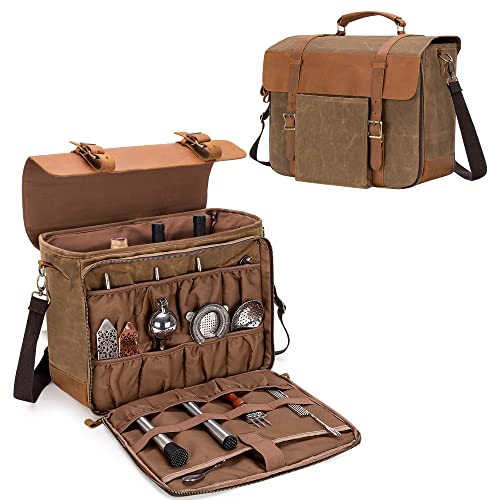 LoDrid Portable Leather Waxed Vintage Bartender Bag | Bar Bag Only: Bartender bag made of leather… Main Compartment: 2 removable thicken cushions divided the… Multiple Pocket: Bar kit bag can meet your… | Check price |
As an Amazon Associate we earn from qualifying purchases at no extra cost to you.
Best professional bartender bags by working situation
| Situation | Best bag type | Useful capacity | Look for | Typical market range |
|---|---|---|---|---|
| Occasional bartender or student | Compact tool-and-bottle bag | 20–30 litres; 2–4 bottles | Removable dividers, wipe-clean lining, padded handle | $45–$90 |
| Weekly private events | Structured shoulder bag | 35–50 litres; 4–8 bottles | Reinforced base, bottle sleeves, exterior tool pockets | $80–$160 |
| High-volume event work | Large backpack or rolling bar case | 55–80 litres; 8–12 bottles | Load-bearing frame, wheels or sternum strap, replaceable dividers | $150–$300 |
| Air or vehicle transport with fragile bottles | Hard-sided protective case | 35–65 litres; usually 4–8 bottles | Closed-cell foam, locking hardware, water-resistant seal | $180–$450 |
Head-to-head: the features that decide whether a bartender bag works
Capacity versus usable capacity
A bag’s advertised litre figure includes every pocket, corner, and lid space. Its useful capacity is lower once dividers and padding are installed. A 40-litre bag may hold six standard 750 ml bottles, a shaker, jigger, strainer, mixing spoon, bar knife, pour spouts, napkins, and a small towel—but it will not comfortably hold six bottles plus ice, glassware, syrups, and a complete garnish station.
Count your load before buying. A useful planning estimate is:
- One 750 ml spirit bottle: approximately 3–4 litres of protected bag volume.
- Shaker, tins, jigger, strainer, spoon, and opener: approximately 5–7 litres.
- Small tools, pourers, towels, and bar consumables: approximately 5 litres.
- Garnishes, syrups, and backup ingredients: approximately 8–15 litres, depending on the menu.
That makes a six-bottle cocktail setup roughly 35–45 litres before adding glassware. Leave 15–20 percent of the interior empty so zippers close without crushing equipment and so you can retrieve tools during service.
Compartment layout
Fixed bottle slots provide the best protection and stop glass from knocking together, but they can waste space when you carry fewer bottles. Adjustable hook-and-loop dividers are more versatile for changing menus, although inexpensive dividers can collapse under heavy bottles.
The most practical layout has a padded bottle compartment at the bottom, a flat tool panel in the lid, and one or two external pockets for items needed repeatedly. A dedicated wet pocket is useful for bar spoons, speed pourers, and a used towel. Keep sharp tools such as peelers and knives in a closed sleeve rather than loose in the main compartment.
A bag designed only as a bottle carrier is often less useful than a slightly smaller bag with intelligent organization. If you work cocktail events, prioritize tool access. If you mainly deliver spirits and mixers to a staffed bar, prioritize bottle density and protection.
Waterproof materials and the base
Look for 600D to 1000D polyester or nylon with a polyurethane coating, sealed or covered seams, and a separate waterproof base. “Water-resistant” usually means the fabric can handle light rain and spills; it does not necessarily mean the bag is safe to leave in standing water.
The base wears first because it contacts floors, vehicle cargo areas, and wet loading zones. A rigid polypropylene or molded plastic bottom is more valuable than an extra decorative pocket. Rubber feet or a raised base also prevent the fabric from sitting in spilled drinks.
For outdoor work, inspect the zipper design. A covered coil zipper sheds rain better than an exposed zipper, while a water-resistant zipper adds protection but may be stiffer and more expensive to replace. No soft bag should be treated as a leakproof container for melting ice.
Bottle protection
Padding must protect the glass from side impacts and from the base. Thin foam sewn into the walls is better than nothing, but removable padded sleeves are easier to replace after compression. The ideal bottle compartment holds the bottle upright, limits movement, and leaves a little clearance around shoulders and caps.
Do not assume every “bottle slot” fits every bottle. Tall gin bottles, wide liqueur bottles, square bourbon bottles, and ceramic bitters bottles have different shapes. Measure your widest bottle and tallest bottle, then compare those dimensions with the compartment’s internal dimensions—not the outside dimensions of the bag.
For valuable or unusual bottles, use individual bottle protectors inside the bag. A soft divider reduces contact; it does not make a soft bag impact-proof. Hard cases with foam inserts offer better protection in vehicle transport, but they are heavier and slower to load.
Shoulder comfort and portability
A fully loaded bartender bag can weigh 18–30 kg, depending on the number of bottles and tools. A shoulder strap that feels comfortable at 8 kg may become painful at event weight. Prefer a wide, padded strap with a non-slip section, reinforced attachment points, and a handle that lets you lift the bag without pulling on the zipper.
Backpack straps distribute weight better for longer walks, stairs, and public transport. Rolling cases are easier on the shoulders but perform poorly on cobblestones, grass, stairs, and crowded venues. A hybrid bag with backpack straps and wheels is convenient when the frame does not consume too much interior space.
For frequent work, divide the load between two smaller bags rather than forcing one oversized bag onto one shoulder. This also gives you a backup option if one bag must remain at the service station.
Decision matrix: which bag should you buy?
| Your priority | Recommended choice | Why | Trade-off |
|---|---|---|---|
| Lowest sensible cost | 20–30 litre compact bag | Enough for tools and a few bottles without paying for unused structure | Limited bottle protection and little room for expansion |
| Changing menus | 35–50 litre adjustable-divider bag | Dividers can be reconfigured for bottles, tins, syrups, and tools | Movable partitions may provide less impact resistance |
| Long walks or public transport | 35–55 litre backpack | Two shoulder straps distribute weight and leave your hands free | Access is slower when the bag is worn |
| Vehicle-based event service | 55–80 litre rolling case | High capacity with less lifting over short distances | Wheels and frame add weight and reduce performance on stairs |
| Fragile premium bottles | Hard case with custom foam | Best resistance to crushing and impact | More expensive, bulky, and less flexible |
How to pack a professional bartender bag
- Put heavy bottles low and close to the centre. This lowers the load’s centre of gravity and reduces tipping.
- Separate glass from metal. Keep shakers, strainers, and jiggers in a padded tool panel so they cannot strike bottles.
- Protect closures. Check that bottle caps and pour spouts are tight, then place bottles upright in sleeves or dividers.
- Keep service tools accessible. Put the opener, jigger, strainer, peeler, and towel in an exterior or lid organizer.
- Pack liquids in secondary containment. Syrups and bitters should go into leak-resistant pouches rather than directly beside clean linens.
- Reserve space for retrieval. An overfilled bag slows service and can damage zippers, dividers, and bottle shoulders.
Ownership realities: what wears out first
Zippers, shoulder-strap stitching, divider fasteners, and the bottom corners usually fail before the main fabric. Examine those areas when comparing bags. A replaceable strap and removable dividers can extend useful life more than a slightly thicker outer fabric.
After each event, empty the bag completely, wipe spills with diluted mild detergent, and let every compartment dry open. Do not store a damp bag closed; odors and mildew often begin in padded seams. Brush grit from zippers before lubricating them with a product suitable for synthetic zipper tracks. Avoid bleach, abrasive cleaners, and machine washing unless the manufacturer specifically permits it.
Inspect the base and bottle sleeves monthly if you work regularly. Retire a bag when padding has compressed enough for bottles to touch, when stitching around handles begins to separate, or when the base no longer keeps moisture away from the contents. A cheap bag used twice a month may cost less overall than an expensive one used twice—but for weekly event work, replacing a worn bag or damaged bottle can quickly erase the initial saving.
Final buying recommendation
For most mobile bartenders, choose a 35–50 litre structured bag made from coated 600D–1000D fabric, with six to eight adjustable padded bottle compartments, a rigid or raised waterproof base, a washable lining, and a wide shoulder strap. Move up to a backpack or rolling case when your route involves long carrying distances or more than eight bottles. Choose a hard case only when protecting expensive bottles is the primary concern.
The right bag is the one that fits your menu with room to retrieve tools—not the one with the biggest number on its label. Measure your bottles, calculate the loaded weight, and prioritize the base, dividers, zipper, and strap attachments before cosmetic features.
More from Amazon
Programs that pair well with the guide above. Offers and eligibility are set by Amazon and may change.
Free shipping on eligible items, Prime Video and more. Eligible new members can start with a free trial.
Start a Prime free trialA Prime membership for ages 18-24 with a trial period. Eligibility is set by Amazon.
See Prime for Young AdultsAudiobooks and podcasts to listen to on the go. Eligible new members can start with a free trial.
Try Audible freeAd-free music streaming. Eligible new subscribers can start with a free trial.
Try Music Unlimited freeAs an Amazon Associate we earn from qualifying purchases.



Write Your Review
No reviews yet. Be the first to share your experience!