

The best hot water dispensers for most kitchens are instant-heating countertop models with selectable temperatures, a 2–4 litre removable tank, an adjustable volume control, and a physical child lock; choose a vacuum-insulated boiler instead if you need many cups at one temperature throughout the day.
Our top picks
 INSINKERATOR HOT250 Instant Hot Water Dispenser System
- 8.21-inch faucet height, 2.97-inch width, single-handle faucet for…
- ON-DEMAND, NEAR-BOILING WATER: Instant hot water (approximately 200…
- STYLISH, SMART DESIGN: Transitional faucet that complements most…
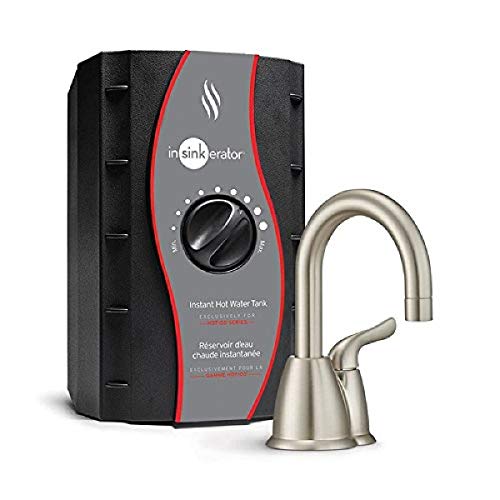 InSinkErator H-HOT150SN-SS Instant Hot Water Dispenser System
- Includes Satin Nickel finish instant hot water dispenser…
- Delivers up to 60 cups/hour of 200 degree…
- We come to you 1-year in-home limited
 INSINKERATOR HOT250 Instant Hot and Cold Water
- 8.21-inch T x 3.96-inch W, 2-handle, satin nickel…
- ON-DEMAND, NEAR-BOILING WATER: Instant hot water (approximately 200…
- Option to add an InSinkErator water filter to…
| Product | Key specs | |
|---|---|---|
| INSINKERATOR HOT250 Instant Hot Water Dispenser System | 8.21-inch faucet height, 2.97-inch width, single-handle faucet for… ON-DEMAND, NEAR-BOILING WATER: Instant hot water (approximately 200… STYLISH, SMART DESIGN: Transitional faucet that complements most… | Check price |
| InSinkErator H-HOT150SN-SS Instant Hot Water Dispenser System | Includes Satin Nickel finish instant hot water dispenser… Delivers up to 60 cups/hour of 200 degree… We come to you 1-year in-home limited | Check price |
| INSINKERATOR HOT250 Instant Hot and Cold Water | 8.21-inch T x 3.96-inch W, 2-handle, satin nickel… ON-DEMAND, NEAR-BOILING WATER: Instant hot water (approximately 200… Option to add an InSinkErator water filter to… | Check price |
 NutriChef 5.2 Qt Hot Water Dispenser with | The NutriChef 5.2 Qt electric water kettle offers… With a simple plug-in setup, button-activated boil, and… Equipped with a thermal safety cut-off to help… | Check price |
As an Amazon Associate we earn from qualifying purchases at no extra cost to you.
Best hot water dispenser by kitchen situation
| Kitchen situation | Best choice | Useful target specifications | Main compromise |
|---|---|---|---|
| One to four drinks a day | Compact instant-heating dispenser | 2–2.5 L tank, 1,500–2,200 W, 100–300 ml presets | Slower when several large servings are dispensed consecutively |
| Tea, coffee, cooking and frequent refills | Large instant-heating dispenser | 3–5 L tank, 2,000–3,000 W, 40–100°C adjustment | Takes more counter depth and uses more electricity at high output |
| Many cups kept hot all day | Vacuum-insulated hot-water boiler | 3–5 L tank, 60–98°C settings, 700–1,000 W reheating | More standby energy and usually slower first heating |
| Limited counter space | Small single-serve instant heater | 1.5–2 L tank, footprint under 20 × 30 cm | Frequent refilling and less room for a large mug |
| Household with children | Lockable dispenser with concealed controls | Two-step dispensing, lock indicator, insulated body | One extra button press for every serving |
Instant heating versus a hot-water boiler
Instant-heating dispensers warm only the water being poured. This can reduce idle heating and gives faster access to a single mug, although the machine may need several seconds before water reaches its selected temperature. They are particularly practical for measured amounts used in instant coffee, tea, cooking, or preparing stock.
A hot-water boiler heats a full tank and maintains it at a selected temperature. Zojirushi and Panasonic are established examples of this type, while Breville HotCup products represent the single-serving dispenser style in some markets. Exact versions and capacities vary by country, so check the rating plate, manual and current specification before buying.
Boilers suit households that pour repeatedly over several hours. They are less efficient when switched on for occasional use, and their first full heating cycle can take considerably longer than an instant dispenser. A useful rule is simple: choose instant heating for irregular use and a boiler for predictable, repeated use.
Heating speed: look beyond the headline wattage
Wattage is useful, but it does not tell the whole story. A 2,000-watt unit can heat a small serving quickly, while a lower-powered boiler may be better at maintaining a large volume. Heating 250 ml of water from 20°C to 90°C requires approximately 20.3 watt-hours before accounting for heat lost through the appliance. A 2,000-watt heater therefore has a theoretical minimum of about 37 seconds; real dispensing takes longer because of heat transfer and control limits.
For daily use, look for:
- A short start-up delay, ideally under 10 seconds for a small serving.
- A stated dispensing rate, not just a wattage figure.
- Continuous heating protection that pauses if the tank runs dry.
- A clear “ready” signal rather than a vague illuminated button.
- A wide enough outlet for a mug, measuring jug or saucepan.
Very fast heating is not always desirable. Water dispensed at near-boiling temperature can splash, and a fast stream makes it harder to stop at an exact volume. A slower, controlled flow is often more useful when filling a French press or adding hot water to a recipe.
Temperature settings and dispensing accuracy
Multiple temperature settings are more valuable than a single “boil” button. A practical range is approximately 45–55°C for dissolving some ingredients, 70–80°C for many green teas, 85–90°C for coffee preparation, and 95–100°C when near-boiling water is required. These are starting points rather than universal brewing rules.
Prefer models with a dedicated temperature display and increments of 5°C or less. Basic appliances may offer only room temperature, warm, and boiling selections. That can be adequate for cooking, but it makes repeatable drinks more difficult.
Volume control is equally important. A dispenser offering 150, 250 and 300 ml presets is convenient, but do not assume the displayed number is exact. Flow can vary as the filter accumulates scale or the tank level changes. For recipes, measure the first few servings in a jug and note the actual output. A manual-pour button is useful when a recipe needs 600 ml rather than a programmed cup size.
Tank capacity, size and refill frequency
A litre of water weighs roughly one kilogram, so a full 4-litre tank adds substantial lifting weight. A large tank is convenient only if it can be removed safely and fits beneath the tap or filter. Check the appliance’s height with the lid open, not merely its closed dimensions.
Estimate capacity from your routine. If two people each use three 250 ml servings plus 500 ml for cooking, daily demand is:
(6 × 250 ml) + 500 ml = 2,000 ml.
A 2-litre tank would leave no allowance for flushing the system or evaporation, so a 2.5–3 litre model is a more comfortable fit. If you use only one or two cups daily, a 1.5–2 litre unit may be preferable because fresher water is easier to manage and the appliance occupies less space.
Safety features worth paying for
A child lock should prevent dispensing with one accidental touch. The strongest arrangements require a lock button followed by a dispense button, or a press-and-hold action. A lock that merely disables temperature changes is less useful because the remaining dispense control may still release hot water.
- Boil-dry protection: stops or reduces heating when the tank is empty.
- Overheat protection: cuts power if an internal sensor detects abnormal temperature.
- Insulated casing: reduces the chance of a dangerously hot exterior.
- Stable base: important when pressing controls with one hand.
- Drip tray: should be removable and large enough to catch overflow.
- Visible water level: prevents the machine being run nearly empty.
Never rely on a lock as a substitute for supervision. Keep the cord away from the front edge, position the outlet beyond a child’s reach, and allow steam to escape without placing the dispenser beneath a cabinet that can be damaged by condensation.
Cleaning, filters and ownership costs
Scale is the component that most often reduces heating speed and dispensing accuracy. It forms faster in hard-water areas and can restrict the outlet, making a nominal 250 ml setting deliver slowly or inconsistently. A useful maintenance routine is to empty unused water daily, rinse the tank every few days, and descale when the manual specifies or when flow visibly changes.
Use the manufacturer’s recommended descaler. Some appliances permit citric-acid solutions; others require a proprietary formula. Do not mix descaling chemicals, and never use abrasive pads on the tank or display. Rinse repeatedly after descaling until there is no odour or taste.
Check whether the filter is washable or replaceable. A removable mesh filter costs less to maintain but does not remove dissolved minerals. An activated-carbon cartridge can improve taste, yet it is a consumable: replacement intervals commonly range from one to three months depending on water quality and usage. Do not leave a used cartridge installed indefinitely, because it can become a hygiene and flow problem.
Common buying mistakes
- Choosing a 5-litre appliance for a two-cup household, then leaving old water sitting in the tank.
- Buying by wattage alone while overlooking temperature control and outlet accuracy.
- Ignoring the open-lid height and discovering that the tank cannot be removed beneath a wall cabinet.
- Assuming “boiling” means every serving reaches 100°C at the outlet.
- Picking a glossy, sealed design with no access to the drip tray or dispensing nozzle.
- Failing to check voltage and plug requirements when buying an imported appliance.
Bottom line
For most daily kitchens, the best hot water dispenser is a 2–3 litre instant-heating model with at least four temperature choices, manual volume control, a removable tank, a physical two-step child lock and accessible parts for descaling. Move up to 3–5 litres when several people need hot water throughout the day. Choose a vacuum-insulated boiler when constant availability matters more than low standby use, and give cleaning access at least as much attention as the speed claim.
More from Amazon
Programs that pair well with the guide above. Offers and eligibility are set by Amazon and may change.
Free shipping on eligible items, Prime Video and more. Eligible new members can start with a free trial.
Start a Prime free trialA Prime membership for ages 18-24 with a trial period. Eligibility is set by Amazon.
See Prime for Young AdultsAudiobooks and podcasts to listen to on the go. Eligible new members can start with a free trial.
Try Audible freeAd-free music streaming. Eligible new subscribers can start with a free trial.
Try Music Unlimited freeAs an Amazon Associate we earn from qualifying purchases.


Write Your Review
No reviews yet. Be the first to share your experience!