

The best filtered shower heads depend on your water problem: choose a replaceable-cartridge head for the most convenient upgrade, a compact inline filter for an existing shower head, or a high-flow filter only when your home has enough water pressure to support it.
Our top picks
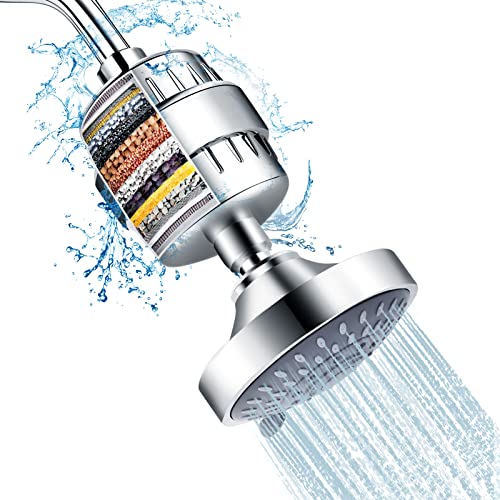 FEELSO Shower Head with Shower Filter
- 【HEALTH CARE SHOWER SYSTEM】- FEELSO Filter shower head…
- 【PURIFY THE WATER, PROTECT YOU】 - Remove Chlorine,…
- 【ADJUSTABLE HIGH PRESSURE SHOWER HEAD】 - 4 Inch…
 Filtered Shower Head
- Upgraded hard water filter showerhead:Featuring calcium sulfate, KDF-55,…
- High Pressure Shower Head with 6 Settings: Our…
- To replace the filter cartridge, simply press the…
 Magichome Filtered Shower Head with Handheld
- 10 Versatile Spray Modes
- High-Pressure Performance with Air-Induction-Induction Tech
- 360° Adjustable Bracket & 59-Inch Flexible Hose
| Product | Key specs | |
|---|---|---|
| FEELSO Shower Head with Shower Filter | 【HEALTH CARE SHOWER SYSTEM】- FEELSO Filter shower head… 【PURIFY THE WATER, PROTECT YOU】 - Remove Chlorine,… 【ADJUSTABLE HIGH PRESSURE SHOWER HEAD】 - 4 Inch… | Check price |
| Filtered Shower Head | Upgraded hard water filter showerhead:Featuring calcium sulfate, KDF-55,… High Pressure Shower Head with 6 Settings: Our… To replace the filter cartridge, simply press the… | Check price |
| Magichome Filtered Shower Head with Handheld | 10 Versatile Spray Modes High-Pressure Performance with Air-Induction-Induction Tech 360° Adjustable Bracket & 59-Inch Flexible Hose | Check price |
 MakeFit Filtered Shower Head | Shower Head Filter for Hard Water: Do you… High Pressure Shower Head with 7 Settings: Our… High Quality & Premium Material: Featuring a beautiful… | Check price |
As an Amazon Associate we earn from qualifying purchases at no extra cost to you.
Quick picks by situation
| Situation | Best choice | Why it fits | Trade-off |
|---|---|---|---|
| Lowest upfront cost | Inline carbon/KDF filter | Works with your existing shower head and usually costs about $15–$35 | Adds length between the shower arm and head |
| Easy replacement and familiar brand | Culligan WSH-C125 | Inline design, KDF media, and a widely available replacement cartridge | Its filtration cartridge is a consumable and may reduce flow as it loads |
| Compact, modern-looking installation | Jolie filtered showerhead | Integrated cartridge and a relatively clean all-in-one design | Fewer spray-style choices than a multifunction shower head |
| High spray coverage | Sprite filtered shower heads | Multiple models use replaceable Chlorgon or Sprite filter cartridges and offer several spray formats | Model-specific flow rates and cartridge costs vary |
| Low water pressure | Low-flow filtered fixed head with a wide spray face | A broad, simple spray can feel fuller than a small massage setting at the same flow rate | A filter cannot repair a restricted pipe, clogged screen, or weak supply |
What filtered shower heads actually filter
Most shower filters are designed to reduce chlorine and sediment, with some media also marketed for reducing certain metals or odors. They do not turn hard water into soft water. Calcium and magnesium hardness generally require a water softener or a professionally designed treatment system, not a small shower cartridge.
The filter media matters more than the word “filtered” on the packaging:
- Activated carbon: useful for chlorine, tastes, odors, and some organic compounds. It works best when water moves slowly enough to contact the media.
- KDF copper-zinc media: commonly used in shower filters, often alongside carbon. It is intended to help manage chlorine and some dissolved metals, but performance depends on the cartridge design and water chemistry.
- Calcium sulfite: frequently used in hot-water shower filters because it can react with chlorine at higher temperatures. It is often combined with other media.
- Vitamin C media: can neutralize chlorine, but cartridges may need more frequent replacement and are not a solution for hardness.
- Polypropylene sediment screens: catch visible particles such as rust or pipe debris. They protect the other media but do not replace chemical filtration.
Look for a published replacement schedule and an independently verifiable performance claim, rather than assuming that a larger-looking filter is automatically better. A compact cartridge may perform well for chlorine but have little capacity for sediment-heavy water.
Head-to-head comparison: the specifications that affect ownership
The figures below describe common configurations and manufacturer-published ranges or typical model specifications. Check the exact version before buying, because one brand may sell several heads with different spray patterns and flow restrictors.
| Product or type | Filter media | Typical flow rate | Replacement interval | Installation | Spray options |
|---|---|---|---|---|---|
| Culligan WSH-C125 | KDF media with filtration cartridge | About 2.5 gallons per minute | About 6 months or 10,000 gallons, depending on water quality | Standard 1/2-inch shower connection; inline or head-mounted configuration | Varies by package; fixed and handheld versions are available |
| Sprite filtered models | Chlorgon, often with additional media depending on model | Commonly 1.75–2.5 gallons per minute | Often about 3–6 months, depending on cartridge and usage | Standard 1/2-inch connection; generally tool-free with plumber’s tape | Fixed, handheld, rain, and combination formats |
| Jolie filtered showerhead | Proprietary multi-stage cartridge including specialty media | About 1.8 gallons per minute | Commonly about 90 days, depending on household use | Replaces a standard shower head on a 1/2-inch arm | Typically one broad spray pattern |
| AquaBliss SF100 inline filter | Multi-stage cartridge with sediment and chemical-filtration media | Designed for standard shower flow; actual flow depends on the attached head | Commonly about 4–6 months | Fits between a 1/2-inch shower arm and existing head | Keeps the spray settings of your existing head |
| Generic compact carbon inline filter | Activated carbon, sometimes with KDF or sediment mesh | Usually 1.8–2.5 gallons per minute | About 2–6 months | 1/2-inch threaded connections; may need an adapter | Determined by the existing shower head |
A lower flow rate can save water, but the experience depends on nozzle design. A 1.8 GPM head with tightly arranged jets may feel more forceful than a poorly designed 2.5 GPM head. Conversely, a restrictive filter or clogged screen can make even a high-flow model disappointing.
Best filtered shower heads for low water pressure
Start by separating a filter problem from a plumbing problem. Remove the existing shower head briefly and run water from the bare shower arm into a bucket. If the flow is weak there too, the likely causes include a partially closed valve, clogged supply screen, old galvanized piping, a pressure regulator issue, or simultaneous water use elsewhere in the home. A filtered shower head will not correct those restrictions.
If the bare pipe has reasonable flow, choose a head with:
- a rated flow of 1.8–2.0 GPM rather than an unnecessarily restrictive “water-saving” design;
- a broad spray face, which distributes limited water more comfortably;
- fewer internal moving parts and no complicated diverter that can restrict the passage;
- a replaceable filter that can be removed when testing flow;
- a cleanable inlet screen.
For low pressure, an inline filter paired with a known good wide-face shower head is often easier to troubleshoot than an all-in-one head. If flow falls after several weeks, remove the cartridge or inspect the inlet screen. A sudden drop usually indicates sediment loading rather than exhausted chlorine media.
Installation: the five-minute job that still goes wrong
- Remove the old head and clean the shower-arm threads. Mineral buildup can prevent a new filter from sealing.
- Confirm the connection size. Most residential shower heads use a 1/2-inch NPT-style connection, but unusual arms and handheld brackets may require an adapter.
- Install plumber’s tape only on male threads. Wrap it clockwise when facing the end of the thread. Do not cover the first thread, and do not use excessive tape inside the fitting.
- Hand-tighten, then make a small adjustment with a wrench. Use a cloth to protect the finish. Overtightening can crack plastic filter housings.
- Flush the cartridge. Run cold or lukewarm water for the period specified by the manufacturer, commonly 1–5 minutes, until loose carbon dust clears.
Keep the filter oriented as indicated. Some inline cartridges are reversible, while others have a defined inlet and outlet. If the unit has a flow restrictor, do not drill it out: that can increase consumption, damage the spray pattern, and void the warranty.
Replacement cost and the part people forget
Filter ownership is best compared by annual cost, not purchase price. Suppose a cartridge costs $18 and lasts four months. The annual filter cost is:
$18 × 12 ÷ 4 = $54 per year
If two people take one 8-minute shower each day and the head flows at 1.8 GPM, annual water use is approximately:
1.8 × 8 × 2 × 365 = 10,512 gallons
That usage may exhaust a cartridge faster than the advertised household average. A three-person household, long showers, rusty plumbing, or heavily chlorinated water can shorten the interval further. Replace the cartridge by time, rated capacity, or noticeable performance change—whichever comes first.
Durability and maintenance realities
The first parts to suffer are usually the cartridge, rubber washer, inlet screen, and diverter—not the spray nozzles themselves. Hard-water scale can block elastomer nozzles and make a spray pattern uneven even when the filter still has capacity.
- Wipe silicone nozzles periodically and flex them gently to release surface scale.
- Clean the inlet screen when flow drops suddenly.
- Do not soak the complete filter housing in vinegar unless the instructions permit it; acid can affect seals and some finishes.
- Replace flattened washers instead of tightening harder.
- Mark the cartridge installation date on the housing.
- Discard a cartridge that has been left unused and wet for an extended period, or follow the manufacturer’s storage instructions.
If your main complaint is white scale on glass, faucets, or skin, a filtered shower head is probably the wrong tool. If the problem is chlorine odor, visible sediment, or an inexpensive way to improve an existing shower, the right cartridge-based filter can be a practical upgrade.
Bottom line
For the simplest all-in-one purchase, choose a reputable filtered head with a clearly stated 1.8–2.5 GPM rating and affordable cartridges. For flexibility, use an AquaBliss SF100, Culligan inline unit, or similar filter with the shower head you already like. For multiple spray settings, compare Sprite’s model-specific options carefully. And for weak pressure, prioritize an unclogged, wide-face low-flow head and diagnose the plumbing before blaming the filter.
More from Amazon
Programs that pair well with the guide above. Offers and eligibility are set by Amazon and may change.
Free shipping on eligible items, Prime Video and more. Eligible new members can start with a free trial.
Start a Prime free trialA Prime membership for ages 18-24 with a trial period. Eligibility is set by Amazon.
See Prime for Young AdultsAudiobooks and podcasts to listen to on the go. Eligible new members can start with a free trial.
Try Audible freeAd-free music streaming. Eligible new subscribers can start with a free trial.
Try Music Unlimited freeAs an Amazon Associate we earn from qualifying purchases.







Write Your Review
No reviews yet. Be the first to share your experience!