

Key takeaways
- Plate matching: Straight edges dull faster on ceramic and stoneware. If your plates are hard glazed stoneware, a serrated blade or a brief honing after each meal helps.
- Storage: Keep steak knives in a block, tray or sleeve, not loose in a drawer where edges knock together and tips can injure fingers.
- Sharpening: Straight-edge sets can be honed on a ceramic rod and sharpened on a whetstone or by a professional. Serrated blades need a tapered rod or a professional service, and many owners simply replace them.
- Children: Store out of reach and supervise any use. A sharp small knife is often more hazardous than a dull one.
- Set size: Count seats at your table. Six is the most common set size, with four-piece sets common in premium ranges.
For most households, a straight-edge forged set such as the Wüsthof Gourmet or Messermeister Avanta is the safest all-round choice, a serrated budget set such as Chicago Cutlery or Victorinox Swiss Classic suits busy kitchens that just want something that cuts, and a Shun Classic or Zwilling Porterhouse set suits people who want a gift-worthy table setting. The right answer depends on how you cook steak, how you wash dishes, and whether you are willing to sharpen. This guide walks through the main options reviewers keep returning to, what the makers state about them, and where each one falls short.
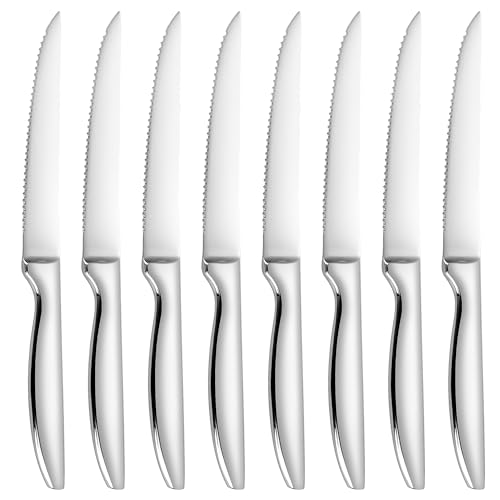
Our top picks


As an Amazon Associate we earn from qualifying purchases at no extra cost to you.
Steak Knives at a Glance
The table below summarises the sets that appear most often in published roundups. Blade lengths and edge types come from the Knife Informer roundup and the makers’ own descriptions; budget tiers are relative rather than exact.
| Set | Best for | Stated blade and edge | Main limit |
|---|---|---|---|
| Wüsthof Gourmet (6-piece) | Best all-round pick for most cooks | About 4.7 inch blade, straight edge | Mid-range outlay; stamped rather than forged |
| Wüsthof Classic | Buyers who want a forged heirloom set | Forged German stainless, straight edge | Premium tier; hand wash only |
| Shun Classic (4-piece) | Premium gift or special-occasion table | About 4.75 inch blade, straight edge | Premium tier; Japanese steel needs gentle care |
| Messermeister Avanta Forged | Value-minded buyers wanting forged feel | About 5 inch blade, straight edge | Only four knives in many sets |
| Chicago Cutlery Walnut Tradition | Budget serrated option with wood handles | About 4.5 inch blade, serrated | Serrations tear fibres; wood needs hand washing |
| Victorinox Swiss Classic (6-piece) | Budget, everyday and family use | About 4.3 inch blade, wavy serrated | Plastic handles, stamped blades |
| Victorinox Grand Maître | Comfort and edge retention on a mid-range budget | Described by KitchnKnife as holding its edge longest | Handle style is a matter of taste |
| Zwilling Porterhouse (4 or 8-piece) | Gifting | About 5 inch blade, straight edge | Mid-range outlay; hand wash advised |
| Laguiole en Aubrac (6-piece) | Rustic French table look | About 4 inch blade, straight edge | Premium tier; short blade |
What Actually Matters in a Steak Knife
Straight edge versus serrated
This is the biggest decision. Knife Informer states that a straight edge produces noticeably cleaner cuts and better mouthfeel, but it dulls faster against ceramic plates and needs periodic honing and sharpening. A serrated edge stays sharp longer and needs less maintenance, and it handles a crusty sear well, yet the same roundup notes it can tear meat fibres, which affects texture and juice retention. If you eat steak weekly and own a sharpening rod, a straight edge rewards the effort. If you eat it a few times a month and never sharpen anything, a serrated blade is the more forgiving choice.
Forged versus stamped
Forged blades are shaped from a single bar of steel and usually include a bolster, giving more weight and balance. Stamped blades are cut from a sheet, so they are lighter and cheaper. For a steak knife, which spends only a few minutes in the hand, the difference matters less than it does for a chef’s knife. Many reviewers treat stamped sets as perfectly adequate for table use, and the Wüsthof Gourmet line is a well-known example of a stamped design that still earns top marks in roundups.
Blade length and handle
Published sets cluster between roughly 4 and 5 inches. Shorter blades feel neat on a small plate; longer ones, like the roughly 5 inch Messermeister Avanta and Zwilling Porterhouse, give a longer slicing stroke through thick cuts. Handles range from plastic to wood to composite. Plastic and composite resist moisture; natural wood looks warm on the table but is the most sensitive to water and heat.
Dishwasher reality
Almost every guide says the same thing. Knife Informer warns that dishwasher detergent and high heat can dull blades, corrode steel and damage handles, and suggests hand washing and drying straight away to extend edge life. Only budget sets with fully synthetic handles are described as technically dishwasher-safe, and even then the maker’s care sheet should be followed. If you cannot face hand washing, favour a plain synthetic-handled set and accept that the edge will fade sooner.
The Main Picks Explained
Wüsthof Gourmet: the all-rounder
Knife Informer names the Wüsthof Gourmet six-piece set its best overall. It lists a blade of about 4.7 inches with a straight edge. The appeal is a balance of sharpness, comfortable handling and a price that sits in the middle of the market rather than the top. The trade-off is that the blades are stamped, so they are lighter than the forged Classic range, and like every straight-edge set they need the occasional honing session.
Wüsthof Classic: the forged upgrade
KitchnKnife places the Wüsthof Classic first in its 2026 list. Its main drawback, according to that review, is the higher outlay. Buyers who want a set that will last decades and sit on the table as a feature piece tend to prefer this forged option, provided they will hand wash it.
Shun Classic: the premium gift
Knife Informer picks the Shun Classic four-piece set as its premium choice, with a blade of about 4.75 inches and a straight edge. Shun’s steel is generally harder than European stainless, which can hold a keen edge longer but is less tolerant of twisting, bone contact or hard plates. It suits couples or small households who entertain occasionally and treat their knives with care.
Messermeister Avanta Forged: the value forged set
Both Knife Informer and KitchnKnife highlight the Messermeister Avanta, the former as best value with a roughly 5 inch straight blade, the latter as best value in its 2026 ranking. It gives forged construction without the premium badge price, which is why it keeps appearing in mid-budget lists. Check how many knives come in the box: some listings are four-piece, which is fine for a couple but short for a family dinner.
Victorinox Swiss Classic: the budget workhorse
Knife Informer names the Victorinox Swiss Classic six-piece set its best budget pick and describes the knives as razor-sharp out of the box. The listed blade is about 4.3 inches with a wavy serrated edge. Its drawbacks are the plastic handles and stamped blades, which look plain on a dinner table. For barbecues, student households and families it is hard to beat on practicality.
Victorinox Grand Maître: comfort first
KitchnKnife calls the Grand Maître the best for comfort and says it stayed sharpest longest in that outlet’s own evaluation. The assessment is the reviewer’s, so treat it as one view among several, but it is worth considering if you have larger hands or dislike thin handles.
Chicago Cutlery Walnut Tradition: wood handle on a budget
This is Knife Informer’s best serrated pick, with a roughly 4.5 inch blade. A secondary summary of Wirecutter’s coverage also reports Chicago Cutlery as a recurring budget recommendation. The wood handles need to stay out of the dishwasher, so the practical advantage over a plastic-handled set is looks, not convenience.
Fit, Care and Safety Notes
- Plate matching: Straight edges dull faster on ceramic and stoneware. If your plates are hard glazed stoneware, a serrated blade or a brief honing after each meal helps.
- Storage: Keep steak knives in a block, tray or sleeve, not loose in a drawer where edges knock together and tips can injure fingers.
- Sharpening: Straight-edge sets can be honed on a ceramic rod and sharpened on a whetstone or by a professional. Serrated blades need a tapered rod or a professional service, and many owners simply replace them.
- Children: Store out of reach and supervise any use. A sharp small knife is often more hazardous than a dull one.
- Set size: Count seats at your table. Six is the most common set size, with four-piece sets common in premium ranges.
Pick X If… Decision Table
| Pick this | If you… |
|---|---|
| Wüsthof Gourmet | want a reliable straight-edge set at a middle budget and will hone occasionally |
| Wüsthof Classic | want a forged set that lasts and are happy to hand wash |
| Shun Classic | want a premium look and a hard, keen Japanese edge for gifts or occasions |
| Messermeister Avanta | want forged feel without the top-tier price |
| Victorinox Swiss Classic | need many knives cheaply and do not want to maintain them |
| Victorinox Grand Maître | prioritise comfort and edge life in a mid-range budget |
| Chicago Cutlery Walnut Tradition | want wood handles and serrations on a budget |
| Zwilling Porterhouse | need a presentable gift set with a longer blade |
| Laguiole en Aubrac | care most about a rustic European table setting |
Budget Tiers in Plain Terms
Budget: Expect stamped blades, plastic or basic wood handles and often serrated edges. The Victorinox Swiss Classic and Chicago Cutlery sets sit here. They are the best fit for casual use and for households that will not baby their knives.
Mid-range: This is where Wüsthof Gourmet, Messermeister Avanta, Zwilling Porterhouse and Victorinox Grand Maître sit. Mid-range forged sets typically balance performance and value most effectively, according to Knife Informer. Most readers should shop here.
Premium: Wüsthof Classic, Shun Classic and Laguiole en Aubrac. You are paying for finish, steel quality and presentation. The performance gain over a good mid-range set at the table is modest, so buy premium for pleasure rather than necessity.
Alternatives Worth Considering
- Single serrated utility knives: If you only cook steak occasionally, a couple of good serrated utility knives can double as steak knives and be useful the rest of the week.
- Chef-style slicing at the board: Many steak cooks slice the rested meat in the kitchen with a sharp carving or chef’s knife and serve it pre-sliced, which removes the need for steak knives altogether on some occasions.
Frequently Asked Questions
Are serrated or straight steak knives better?
Straight edges give cleaner cuts and are easier to sharpen, but they dull faster on ceramic plates. Serrated edges stay sharp longer and cope with a crisp crust, yet reviewers note they can tear the meat. Choose by how willing you are to maintain the blades.
How many steak knives do I need?
Match the number to your regular table. Six is the most common set size, while some premium sets come as four. If you host often, consider buying a second set or an eight-piece option.
Can steak knives go in the dishwasher?
Most guides advise against it because detergent and heat can dull edges and damage handles. Only simple synthetic-handled sets are described as dishwasher-safe, and the maker’s instructions should always take priority. Hand washing and drying is the safest routine.
Is a forged set worth the extra cost?
Forged knives feel weightier and balanced, and they often last decades with care. For table use the performance gap over a good stamped set is small. Buy forged if you value heft and longevity, and stamped if you want value.
How do I sharpen steak knives?
Straight edges can be honed with a fine rod and sharpened on a whetstone or by a professional service. Serrated knives need a tapered sharpening tool, and many owners replace them when they dull. Keep any sharpening gentle and follow the maker’s guidance.
What blade length is best?
Most published sets fall between about 4 and 5 inches. Shorter blades suit smaller plates and lighter cuts, while roughly 5 inch blades give a longer stroke through thick steaks. Try to hold one before buying if you have small or large hands.
More from Amazon
Programs that pair well with the guide above. Offers and eligibility are set by Amazon and may change.
Free shipping on eligible items, Prime Video and more. Eligible new members can start with a free trial.
Start a Prime free trialA Prime membership for ages 18-24 with a trial period. Eligibility is set by Amazon.
See Prime for Young AdultsAudiobooks and podcasts to listen to on the go. Eligible new members can start with a free trial.
Try Audible freeAd-free music streaming. Eligible new subscribers can start with a free trial.
Try Music Unlimited freeAs an Amazon Associate we earn from qualifying purchases.









Write Your Review
No reviews yet. Be the first to share your experience!