

The best electric knife sharpeners for home cooks are the Chef’sChoice Trizor XV, Work Sharp Culinary E5, and a basic two-stage pull-through model such as the Presto EverSharp, depending on whether you prioritize edge geometry, versatility, or low cost.
Our top picks
 Chef’sChoice 15XV EdgeSelect Professional Electric Knife Sharpener
- Ideal for converting traditional 20-degree factory edges of…
- Advanced stropping stage and 100 percent diamond abrasives…
- Advanced, patented flexible spring guides for automatic adjustment…
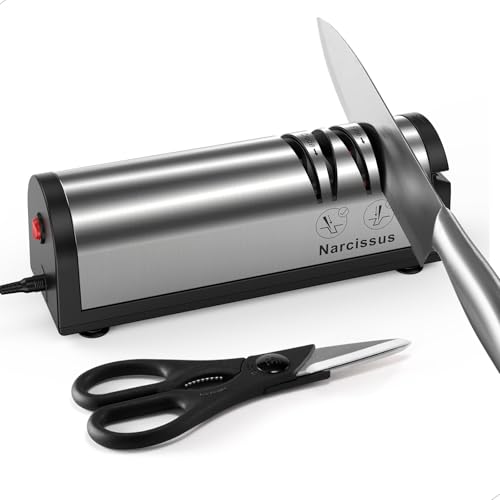 Narcissus Knife Sharpener
- Professional Knife Sharpener for Home - QN-M866 Electric…
- 2 Stage Design to Sharpen & Polish -…
- Quick and Simple Sharpening - Simply insert your…
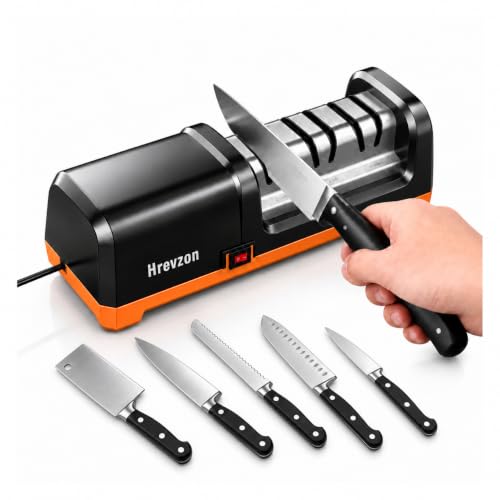 Electric Knife Sharpener 100% Diamond Abrasives
- Premium 100% Diamond Abrasive: Crafted with industrial-grade full…
- 3-Stage Professional Sharpener: This versatile kitchen knife sharpener…
- Effortless One-Pull Operation: Zero professional sharpening skills needed,…
| Product | Key specs | |
|---|---|---|
| Chef’sChoice 15XV EdgeSelect Professional Electric Knife Sharpener | Ideal for converting traditional 20-degree factory edges of… Advanced stropping stage and 100 percent diamond abrasives… Advanced, patented flexible spring guides for automatic adjustment… | Check price |
| Narcissus Knife Sharpener | Professional Knife Sharpener for Home - QN-M866 Electric… 2 Stage Design to Sharpen & Polish -… Quick and Simple Sharpening - Simply insert your… | Check price |
| Electric Knife Sharpener 100% Diamond Abrasives | Premium 100% Diamond Abrasive: Crafted with industrial-grade full… 3-Stage Professional Sharpener: This versatile kitchen knife sharpener… Effortless One-Pull Operation: Zero professional sharpening skills needed,… | Check price |
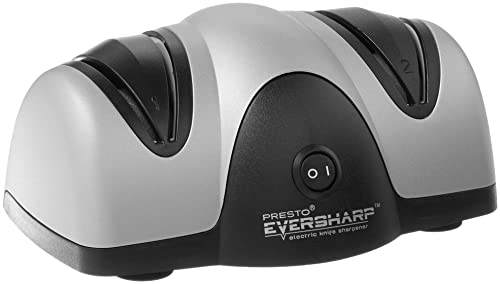 Presto 08800 EverSharp Electric Knife Sharpener | Sharpen kitchen and sport knives to a razor-sharp… Easy 2-stage sharpening system for professional results at… Sapphirite sharpening wheels grind a precisely angled edge… | Check price |
As an Amazon Associate we earn from qualifying purchases at no extra cost to you.
Quick picks by cooking situation
| Situation | Best fit | Why | Main compromise |
|---|---|---|---|
| Most Western kitchen knives | Chef’sChoice Trizor XV | Fixed 15-degree-per-side edge, diamond abrasives, three stages | Can remove too much steel if used for routine honing |
| Mixed household knives and frequent touch-ups | Work Sharp Culinary E5 | Flexible abrasive belts and guided sharpening angle | Belts are consumables and the system has a learning curve |
| Lowest purchase cost | Presto EverSharp | Simple two-stage design for standard kitchen knives | Less control over angle and more limited specialty-blade support |
| Japanese-style knives | A sharpener with a selectable 15-degree setting | Better match for many thinner double-bevel blades | Confirm the model supports the knife’s construction before sharpening |
What separates the best electric knife sharpeners
An electric sharpener is not simply a motor with an abrasive wheel. Its results depend on four linked decisions: how many stages it uses, what each abrasive is made from, the angle it creates, and how much metal it removes on every pass.
Sharpening stages
A two-stage sharpener usually combines a coarse stage for reshaping a damaged edge with a fine stage for refining it. This is adequate for ordinary blunt knives, but it may leave a less polished edge than a three-stage system.
A three-stage sharpener commonly uses:
- A coarse diamond stage to establish or repair the bevel.
- A finer diamond or abrasive stage to refine the edge.
- A polishing or stropping stage to reduce burrs and improve slicing feel.
More stages do not automatically mean better sharpening. A coarse stage is aggressive by design. If a knife only needs a light touch-up, repeatedly using that stage shortens the blade unnecessarily. The useful question is whether the sharpener gives you a gentle maintenance stage, not just whether it advertises three stages.
Abrasive materials
Diamond abrasives cut quickly and are effective on hard stainless steel, but coarse diamond wheels can remove substantial steel. Ceramic abrasives are usually better suited to fine refinement and polishing. Flexible abrasive belts, used in systems such as the Work Sharp Culinary E5, conform more readily to different blade profiles and can produce a smooth convex edge, but the belts eventually wear and need replacement.
Do not confuse “diamond” with “gentle.” Abrasive grade matters. A fine diamond stage can be suitable for maintenance; a coarse diamond stage is better reserved for a damaged or very dull edge.
Angle guides
Most electric pull-through sharpeners guide the knife at a fixed angle, often 15 or 20 degrees per side. A 15-degree-per-side setting creates a thinner, more acute edge that can slice efficiently but may be less forgiving on hard cutting boards or rough tasks. A 20-degree-per-side setting is common for durable Western chef’s knives and utility knives.
Some sharpeners use a total included angle rather than an angle per side in their descriptions, so check the manual. “30 degrees” may mean 15 degrees on each side, not a 30-degree angle on each side.
Head-to-head: the leading types
Chef’sChoice Trizor XV: best for a consistent 15-degree edge
The Chef’sChoice Trizor XV is designed around a 15-degree-per-side edge and uses a three-stage sequence with diamond abrasives and a polishing stage. It suits cooks who mainly use double-bevel Western or Japanese-style kitchen knives and want a repeatable result without learning freehand sharpening.
Its biggest strength is consistency. The guides control the angle, while the stages make it possible to reshape, refine, and polish. It can also handle many serrated knives through its dedicated serrated-knife stage, although serrations should not be dragged through a smooth straight-edge slot.
The ownership risk is over-sharpening. If your knife is already sharp, beginning in the coarse stage can remove far more steel than necessary. For routine maintenance, use the finishing stage only when the manufacturer’s instructions permit it, and make the fewest passes needed.
Work Sharp Culinary E5: best for versatility and controlled maintenance
The Work Sharp Culinary E5 uses flexible abrasive belts rather than enclosed grinding wheels. Its guided design is intended to accommodate common kitchen knives, and its belt system can be more forgiving around curved profiles and varied blade shapes.
This type is attractive for households with chef’s knives, paring knives, cleavers, and other non-identical blades. It is also useful when you want a gentler maintenance approach than a permanently aggressive coarse wheel. However, belt sharpeners still remove metal quickly if held in place or used with excessive pressure.
Belts are the first consumable likely to wear. Keep replacement belts available, and clean away metal dust according to the manual rather than washing it into the mechanism. Serrated and specialty blades require particular care: a standard belt or slot may flatten serration peaks or damage an unusual bevel.
Presto EverSharp: best for occasional budget sharpening
The Presto EverSharp is a compact two-stage electric sharpener aimed at ordinary household knives. Its appeal is simplicity: a coarse stage establishes the edge and a finer stage improves it, without the price or complexity of a multi-stage premium machine.
It is a reasonable choice when most of your knives are inexpensive, double-bevel, and already close to a usable edge. It is less suitable for premium Japanese knives, thick cleavers, heavily serrated blades, or anyone who wants precise control over multiple edge angles.
Budget sharpeners often have less generous blade guides. Keep the knife vertical, use light pressure, and avoid pushing the blade tip down into a slot. That common mistake can round the tip and create an uneven bevel.
Angle and compatibility guide
| Blade type | Typical target | Preferred sharpener feature | Risk to watch |
|---|---|---|---|
| Western chef’s knife | 18–22 degrees per side | 20-degree guide or adjustable guide | Too acute an angle may chip during heavy use |
| Thin Japanese double-bevel knife | 12–16 degrees per side | Accurate 15-degree setting and fine stage | Coarse grinding can remove valuable steel quickly |
| Utility or pocket-style blade | 18–25 degrees per side | Angle range that matches the manufacturer’s specification | Some kitchen sharpeners cannot safely hold short blades |
| Serrated bread knife | Bevel varies by gulley | Dedicated serrated sharpening slot or tapered ceramic rod | A straight slot can destroy the serration pattern |
| Single-bevel knife | Manufacturer-specific | Equipment designed for single-bevel geometry | Sharpening both sides can ruin the intended edge |
How much steel does electric sharpening remove?
There is no universal amount because it depends on pressure, number of passes, abrasive wear, blade hardness, and how far the edge has been damaged. The practical rule is to treat a coarse stage as repair equipment, not a substitute for honing.
For a routine touch-up, start with one or two light passes in the finest appropriate stage. Test the edge on paper or a tomato. If it is still dull, add one pass at a time. Do not use a coarse stage simply because it is the first slot.
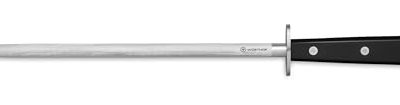
Electric sharpeners are especially valuable when a knife has a visible flat spot, chips, or a completely rounded edge. They are less economical for maintaining a sharp knife that only needs occasional alignment. A honing rod or fine manual ceramic rod can preserve an existing edge with less material removal, provided it matches the knife’s angle and is used correctly.
Setup and maintenance that extend sharpener life
- Place the machine on a stable, dry surface before switching it on.
- Clean and dry the knife first; food residue can clog abrasive surfaces.
- Use light, even pressure. Let the abrasive do the cutting.
- Pull the blade smoothly from heel to tip at the speed specified by the manual.
- Do not stop with one section of the edge inside the slot.
- Use the correct slot for serrated knives rather than improvising.
- Unplug the unit before cleaning, and remove metal filings as directed.
- Replace worn belts or damaged abrasive assemblies instead of compensating with extra pressure.
For frequent home cooking, a fine maintenance stage and replaceable abrasives matter more than a high motor wattage. For occasional use, a simple two-stage unit may be sufficient, especially if your knives are inexpensive and standard in shape.
Bottom line
Choose the Chef’sChoice Trizor XV when you want a precise 15-degree-per-side edge and a dedicated serrated stage. Choose the Work Sharp Culinary E5 when your knife collection is varied and you value flexible belts and guided maintenance. Choose the Presto EverSharp when cost and simplicity matter most.
Whichever model you select, the best electric knife sharpeners are used sparingly: match the angle to the blade, reserve coarse abrasives for genuine repairs, and confirm compatibility before sharpening serrated, single-bevel, ceramic, or unusually thick knives.
More from Amazon
Programs that pair well with the guide above. Offers and eligibility are set by Amazon and may change.
Free shipping on eligible items, Prime Video and more. Eligible new members can start with a free trial.
Start a Prime free trialA Prime membership for ages 18-24 with a trial period. Eligibility is set by Amazon.
See Prime for Young AdultsAudiobooks and podcasts to listen to on the go. Eligible new members can start with a free trial.
Try Audible freeAd-free music streaming. Eligible new subscribers can start with a free trial.
Try Music Unlimited freeAs an Amazon Associate we earn from qualifying purchases.
Write Your Review
No reviews yet. Be the first to share your experience!