

Key takeaways
- Chef’s knife (8 inch): The workhorse; this is where to judge a set.
- Paring knife: For peeling, trimming and small jobs.
- Serrated bread knife: Useful for loaves and tomatoes.
- Utility or boning knife: Occasional use; matters if you break down chicken.
- Honing steel: Maintains edge between sharpenings and is included in many blocks.
- Kitchen shears: Frequently included; check they come apart for cleaning if that matters to you.
- Steak knives: Included in the larger Wusthof sets, though they are only worth having if you serve steaks regularly.
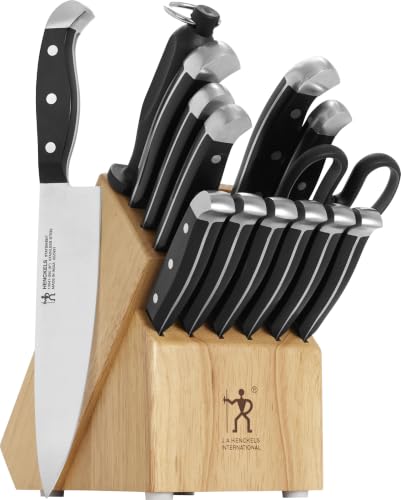
For most home cooks, a forged German block set such as the Wusthof Classic is the benchmark that expert roundups return to, a stamped Victorinox Fibrox Pro set is the practical budget favourite, and Henckels Classic sets are the choice for buyers wanting many pieces without the top price. This guide compares the sets that reviewers keep coming back to, what the forged and stamped difference really means, and which pieces in a set are worth having.
Our top picks


As an Amazon Associate we earn from qualifying purchases at no extra cost to you.
What Experts Keep Picking
Forbes Vetted’s recent knife set guide names the Wusthof Classic 7-Piece Slim Block Set as best overall for most home cooks. Its other categories include the Mercer Culinary Genesis 6-Piece for value, the Wusthof Classic 15-Piece for a set with steak knives, the Misen 3-Piece for a basic set and the Miyabi Artisan 7-Piece for Japanese style. Aggregator sites that summarise Wirecutter, Serious Eats, America’s Test Kitchen and Good Housekeeping also place Wusthof Classic at or near the top, name Victorinox Fibrox Pro as best value, and list Henckels Classic as a complete set option. These secondary summaries did not all reproduce the original tests, so treat them as a consensus signal rather than a lab result.
One aggregator relays a Serious Eats test of nine sets from April 2026 that used a sharpness reader, reporting that the stamped Wusthof Gourmet performed well on edge retention against several forged rivals. That is an interesting reminder that stamped does not automatically mean worse, but because the claim comes second-hand it is best taken as a pointer.
Sets at a Glance
| Set | Best for | Stated specs and notes | Limits |
|---|---|---|---|
| Wusthof Classic block sets (7, 8 or 15 pieces) | Buyers wanting long-term German forged knives | Forged from a single bar of high-carbon stainless, full tang with triple rivets, reviewers cite about 58 HRC, made in Solingen, Germany | Premium tier; heavier than stamped options |
| Victorinox Fibrox Pro sets | Value-focused cooks | Stamped blades with molded Fibrox handles, roughly 55 to 56 HRC per one comparison, Swiss maker; easy to sharpen | Partial tang, lighter feel; softer steel means more frequent honing |
| Henckels Classic sets (about 15 or 16 pieces) | Buyers wanting a complete block with extras | Roundups rank it just behind Wusthof and report similar cutting in basic tests | Larger blocks take counter space; extra pieces may go unused |
| Mercer Culinary Genesis 6-Piece | Lower-cost forged option | Named best value by Forbes Vetted | Fewer pieces |
| Miyabi Artisan 7-Piece | Japanese-style blades | Named best Japanese set by Forbes Vetted | Premium tier; thinner edges need gentler use |
| Misen 3-Piece | Minimalists | Named best basic set by Forbes Vetted | Only the essentials |
Forged or Stamped: What Changes
Forged
A forged blade starts as a bar of steel that is heated, hammered and shaped, often with a bolster between blade and handle. Wusthof Classic is the standard example. The result is typically heavier, with a full-width tang and balance that many cooks like for extended chopping. Forged knives usually cost more.
Stamped
A stamped blade is cut from a flat sheet of steel and then ground and heat-treated. Victorinox Fibrox Pro is stamped. These knives are lighter, often cheaper and, as reviewers note, easy to sharpen. Many cooks cannot tell the difference in daily use, and one comparison says most cooks would not notice a performance difference in a blind test.
What this means for you
If you value a substantial feel and a build intended to last decades, forged is attractive. If you prefer a light knife and a budget that goes further, stamped sets can hold their own. Hardness figures differ between sources; one comparison puts Wusthof near 58 HRC and Victorinox at 55 to 56, and sources disagree on the exact steel grades, so rely on the maker’s own literature if the specific alloy matters to you.
Which Pieces Matter in a Set
- Chef’s knife (8 inch): The workhorse; this is where to judge a set.
- Paring knife: For peeling, trimming and small jobs.
- Serrated bread knife: Useful for loaves and tomatoes.
- Utility or boning knife: Occasional use; matters if you break down chicken.
- Honing steel: Maintains edge between sharpenings and is included in many blocks.
- Kitchen shears: Frequently included; check they come apart for cleaning if that matters to you.
- Steak knives: Included in the larger Wusthof sets, though they are only worth having if you serve steaks regularly.
A set with ten knives you rarely use is not better than a smaller set of the right three. Sets typically save money compared with buying separately, but only if you would have bought most of the pieces anyway.
Fit, Storage and Care
- Block footprint: Slim blocks, like the seven-piece Wusthof option named by Forbes, save counter space. Fifteen-piece blocks are large.
- Hand wash: German and Swiss makers generally advise hand washing to protect edges and handles, even if some handles are labelled dishwasher-safe.
- Honing: Use a honing steel regularly for gentle realignment; sharpen on stones or with a service when edges dull.
- Edge angle: Reviewers cite about 15 degrees per side for Victorinox and 14 for Wusthof’s PEtec edge, which is useful if you sharpen at home.
- Cutting boards: Wood or soft plastic boards protect edges; avoid glass and stone.
- Safety: Store knives securely, away from children, and cut away from your body with a stable board.
Budget Tiers
Budget: Victorinox Fibrox Pro and Mercer Culinary Genesis are the names reviewers cite for value. Expect lighter handles and fewer extras.
Mid-range: Henckels Classic sets and smaller Wusthof Classic blocks fit here, with forged construction and decent block sizes.
Premium: Larger Wusthof Classic sets and Miyabi Artisan sets sit at the top of the range. They reward cooks who maintain and use the knives often.
Pick X If… Decision Table
| Pick this | If you… |
|---|---|
| Wusthof Classic 7-Piece Slim Block | want a respected forged set without a huge block |
| Wusthof Classic 15-Piece | want steak knives and a full block in one purchase |
| Victorinox Fibrox Pro set | prefer light knives, easy sharpening and good value |
| Henckels Classic set | want a complete forged block at a gentler tier than Wusthof |
| Miyabi Artisan 7-Piece | prefer thin Japanese-style edges and a premium look |
| Misen 3-Piece | only need chef, paring and bread knives |
Alternatives to a Block Set
Build your own trio
Many cooks buy a chef’s knife, paring knife and bread knife individually, often mixing brands, and add a block or magnetic strip later. This avoids paying for pieces you will not use.
Magnetic strip or in-drawer tray
If counter space is tight, buy knives individually and store them on a wall strip or in a drawer tray with edge guards.
Japanese-style single knives
Harder, thinner knives from Japanese makers can outperform sets on delicate work but need more careful handling.
Handle Feel and Balance
Handle comfort is personal, and it matters as much as the steel. Wusthof Classic uses a traditional triple-riveted handle with a full tang, which reviewers describe as substantial and balanced toward the heel. Victorinox Fibrox Pro uses a molded textured handle that stays grippy when wet and is light in the hand. Henckels Classic also uses riveted handles. If you have small hands, a lighter knife may reduce fatigue. If you have large hands, a longer handle and heavier bolster may feel more secure. Whenever possible, hold a chef’s knife in a store before choosing a block, since the chef’s knife is the piece you will use most.
Hardness, Sharpness and Maintenance Trade-offs
Harder steel generally holds an edge longer but is more brittle and may chip if twisted against bone or hard surfaces. Softer steel dulls sooner but is tougher and quick to restore. This is why reviewers describe Victorinox as easy to sharpen and Wusthof as longer lasting between sharpenings. Neither is universally better; the best match depends on whether you prefer to touch up the edge often or rarely. A honing steel, ceramic rod or a small whetstone kit is worth adding if the block does not include one. Professional sharpening services are an option for people who do not want to learn stone work.
Frequently Asked Questions
Is a more expensive knife set always better?
Not necessarily. Reviewers note that stamped Victorinox knives deliver strong performance for the cost, and some say the difference from forged knives is hard to notice in daily cooking. Higher tiers add heft, a full tang and longevity that some cooks value.
How many pieces do I need?
Most kitchens depend on a chef’s knife, paring knife and serrated knife. Extras like utility knives, shears and steak knives are useful only if you reach for them. A smaller set of quality pieces often beats a large block of fillers.
Can I put knife sets in the dishwasher?
Makers generally recommend hand washing. The dishwasher can dull edges, knock blades together and damage handles. Wash, dry and store promptly.
What does HRC mean?
HRC stands for Rockwell hardness. Higher numbers usually mean a blade holds an edge longer but can be harder to sharpen and more prone to chipping. One comparison lists Wusthof around 58 and Victorinox around 55 to 56, though makers’ figures can differ.
How often should I sharpen my knives?
It depends on use, board type and steel. Honing frequently helps maintain the edge, and full sharpening is needed when honing no longer restores cutting performance. Victorinox blades are described as quick to sharpen.
Should I buy a set with a block or without?
A block protects edges and keeps knives within reach but takes counter space. Slim blocks and in-drawer storage suit smaller kitchens. Choose according to where you will actually keep the knives.
More from Amazon
Programs that pair well with the guide above. Offers and eligibility are set by Amazon and may change.
Free shipping on eligible items, Prime Video and more. Eligible new members can start with a free trial.
Start a Prime free trialA Prime membership for ages 18-24 with a trial period. Eligibility is set by Amazon.
See Prime for Young AdultsAudiobooks and podcasts to listen to on the go. Eligible new members can start with a free trial.
Try Audible freeAd-free music streaming. Eligible new subscribers can start with a free trial.
Try Music Unlimited freeAs an Amazon Associate we earn from qualifying purchases.



Write Your Review
No reviews yet. Be the first to share your experience!