

The best garage freezers for seafood are garage-ready chest freezers if you have floor space, while a garage-ready upright freezer is the better choice when organization and frequent access matter more than maximum efficiency.
A garage is a harder environment than a kitchen: summer heat makes the compressor run longer, winter cold can confuse some electronic controls, and seafood storage demands stable temperatures with little air exposure. Look for a freezer rated for the temperature range of your garage—not merely a model advertised as “garage friendly”—and choose enough capacity to leave room for air circulation around packages.
Our top picks
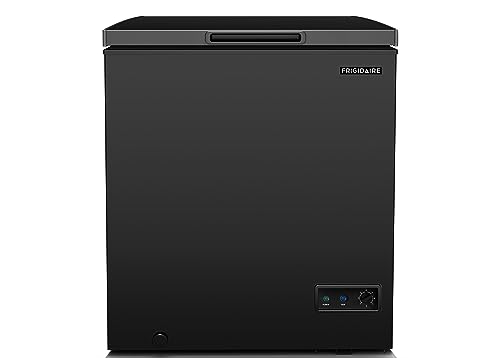 FRIGIDAIRE EFRF5003-BLACK Chest Deep Freezer-Garage-Ready
- Large Storage Capacity - Effortlessly store frozen food…
- Adjustable Thermostat - Set the temperature with ease…
- Effortless Organization - Equipped with a removable vinyl-coated…
 Igloo 3.5 Cu Ft. Upright Deep Freezer
- Spacious Capacity: Our white deep freezer offers 3.5…
- Quick Freezing System: This chest freezer uses a…
- Precise Temperature Control: This upright deep freezer has…
 FRIGIDAIRE EFRF7003-BLACK Chest Deep Freezer
- Large Storage Capacity - Effortlessly store frozen food…
- Adjustable Thermostat - Set the temperature with ease…
- Effortless Organization - Equipped with a removable vinyl-coated…
| Product | Key specs | |
|---|---|---|
| FRIGIDAIRE EFRF5003-BLACK Chest Deep Freezer-Garage-Ready | Large Storage Capacity - Effortlessly store frozen food… Adjustable Thermostat - Set the temperature with ease… Effortless Organization - Equipped with a removable vinyl-coated… | Check price |
| Igloo 3.5 Cu Ft. Upright Deep Freezer | Spacious Capacity: Our white deep freezer offers 3.5… Quick Freezing System: This chest freezer uses a… Precise Temperature Control: This upright deep freezer has… | Check price |
| FRIGIDAIRE EFRF7003-BLACK Chest Deep Freezer | Large Storage Capacity - Effortlessly store frozen food… Adjustable Thermostat - Set the temperature with ease… Effortless Organization - Equipped with a removable vinyl-coated… | Check price |
 7.0 Cu Ft Chest Freezer | Energy Efficient Design - This 7.0 Cu Ft… Quiet Operation - Designed with quiet technology, this… Adjustable Temperature Control - Equipped with a 6-setting… | Check price |
As an Amazon Associate we earn from qualifying purchases at no extra cost to you.
Quick comparison: which garage freezer fits your situation?
| Freezer type | Typical usable capacity | Approximate footprint | Garage temperature suitability | Defrost | Typical annual energy use | Best for |
|---|---|---|---|---|---|---|
| Compact chest freezer | 3.5–7 cu. ft. | 22–38 in. wide | Often about 0–110°F, model dependent | Manual | 180–300 kWh | Small households, occasional fishing trips |
| Medium chest freezer | 8–14 cu. ft. | 40–55 in. wide | Often about 0–110°F, model dependent | Manual | 250–450 kWh | Regular seafood storage and bulk buying |
| Large chest freezer | 15–25 cu. ft. | 55–75 in. wide | Often about 0–110°F, model dependent | Manual | 350–650 kWh | Large families, frequent anglers, whole-fish storage |
| Garage-ready upright | 13–21 cu. ft. | 28–34 in. wide | Commonly listed for roughly 0–110°F, model dependent | Manual or frost-free | 350–700 kWh | Easy access, labeled packages, narrow floor space |
These are planning ranges rather than guarantees. Energy use varies with ambient temperature, insulation, age, door openings and the freezer’s EnergyGuide rating. Check the exact specification sheet before purchase, especially if your garage falls below 40°F in winter or above 90°F in summer.
Best choices by garage and buying situation
Best for lowest running cost: a medium manual-defrost chest freezer
A chest freezer generally loses less cold air when opened because cold air stays inside the box. It also has thick insulation and fewer moving parts than many upright models. A 7–10 cu. ft. model is a practical size for frozen fillets, shrimp, scallops and bait without taking over the garage.
The trade-off is access. Packages at the bottom can become a frozen pile, so use removable wire baskets and stack seafood vertically in labeled, flat packages. A manual-defrost chest freezer is usually the strongest choice when energy use and long-term reliability matter more than convenience.
Best for frequent cooking: a garage-ready upright freezer
An upright freezer is easier to organize by species and date. Shelves or drawers let you separate salmon, white fish, shellfish and prepared portions without unloading the entire cabinet. It is also a better fit for a narrow garage aisle because it uses vertical space.
Uprights usually cost more to run than equivalent chests, particularly in a hot garage, because opening the door releases a column of cold air. Frost-free models avoid routine defrosting, but their fans, heaters and sensors add complexity. For seafood, choose an upright with solid drawers or adjustable shelves that can hold vacuum-sealed packages without bending or puncturing them.
Best for a hot garage: an insulated chest with a wide operating range
If summer garage temperatures regularly reach 95–110°F, prioritize the stated ambient operating range and insulation over exterior appearance. A freezer rated to 110°F is preferable to a standard indoor model, but it still needs clearance for heat to escape. Leave the manufacturer’s recommended space—often at least 2–4 inches around the cabinet—and keep it away from direct sunlight and water heaters.
In extreme heat, compressor run time will increase. A temperature alarm is useful because a freezer can appear to be working while slowly warming due to a failed fan, blocked condenser area or worn door seal.
Best for a cold garage: a model specifically rated below freezing
Cold garages require as much attention as hot ones. Some freezers are designed to operate only when the surrounding air remains above approximately 40°F. In a colder space, the thermostat may not call for cooling often enough, or the control system may behave unpredictably.
Look for a manufacturer-stated garage operating range that includes your winter low. If the documentation does not state a lower ambient limit, contact the manufacturer rather than assuming the freezer is suitable. Avoid placing a freezer beside an uninsulated exterior door where temperature swings are greatest.
Capacity: calculate for seafood, not the advertising number
Freezer capacity is listed in cubic feet, but usable space is reduced by baskets, shelves, compressor humps and the need to avoid tightly blocking air circulation. For packaged seafood, allow approximately 1 cubic foot per 30–35 pounds of neatly packed food. Bulky whole fish, irregular containers and bait require more room.
For example, suppose you keep 80 pounds of vacuum-sealed fillets, 12 pounds of shrimp and several ice packs. At 32 pounds per cubic foot, the food itself needs about 3.1 cubic feet. Adding roughly 40 percent for baskets, gaps and future purchases gives 4.3 cubic feet. A 5–7 cu. ft. freezer would work, but an 8–10 cu. ft. model would be easier to organize and less likely to be overfilled.
Do not fill a chest freezer to the lid with loose packages. Overpacking can block the interior walls or prevent the lid from sealing evenly. Flat packages also freeze and stack more efficiently than round containers.
Manual defrost versus frost-free
- Manual defrost: Usually more efficient and mechanically simpler. It requires defrosting when ice reaches about 1/4 inch, commonly once or twice a year in a well-sealed chest freezer.
- Frost-free: More convenient for upright storage and frequent access. Automatic defrost cycles use additional energy and may produce small temperature fluctuations, but a properly operating model remains suitable for frozen seafood.
- Frost management: Ice buildup is often caused by warm, humid air entering through a damaged gasket or packages preventing the lid from closing. Fix the seal before assuming the freezer needs more cooling power.
To manually defrost, move the food into insulated coolers, unplug the appliance, let the ice soften and remove it with a plastic scraper. Never use a knife, heat gun or open flame. Dry the interior completely before restarting, then wait until the freezer returns to 0°F or below before restocking.
Energy cost: the cheaper freezer may not be the cheaper owner
Use the EnergyGuide estimate and your electricity rate to compare models. The calculation is:
Annual operating cost = annual kWh × electricity price per kWh.
For example, a freezer rated at 360 kWh per year costs about $54 annually at $0.15 per kWh. A larger or less efficient model rated at 520 kWh costs about $78 at the same rate. In a hot garage, actual use can exceed the label estimate, so allow a margin when comparing running costs.
Also consider purchase price, delivery, defrost labor and the cost of spoiled seafood after a temperature failure. A modestly more efficient freezer with a reliable alarm may be better value than the cheapest cabinet available.
Features that matter for seafood storage
- Adjustable thermostat: Set the freezer near 0°F; verify with an independent freezer thermometer rather than trusting the dial position.
- Temperature alarm: Choose an audible or remote alarm that warns when the cabinet rises above your chosen threshold.
- Drain plug: Particularly useful on manual-defrost chest freezers.
- Removable baskets: Helpful for separating small bags, bait and frequently used items.
- Strong gasket: Inspect for an even seal around the complete lid or door.
- Lock: Useful in detached garages and helps prevent a lid from being left partly open.
- Interior light: More valuable in an upright, where packages can hide toward the back.
Setup and maintenance that prevent seafood loss
- Place the freezer on a level, solid surface with the specified ventilation clearance.
- Wait for the unit to reach 0°F or below before loading it with food.
- Divide seafood into meal-size portions, remove excess air, and label species, weight and freezing date.
- Leave gaps around interior walls and vents; do not press packages against a temperature sensor.
- Check the temperature weekly and inspect the gasket monthly.
- Clean spills promptly with mild detergent and water, then dry the interior thoroughly.
- Keep a written inventory so older packages are used first.
Vacuum-sealed seafood should still be kept continuously frozen and handled according to safe food-storage guidance. If the freezer has warmed substantially, do not judge safety by smell alone; follow local food-safety recommendations for evaluating thawed food.
Bottom line
Choose a 5–10 cu. ft. manual-defrost chest freezer for economical storage of regular seafood purchases, a 10–16 cu. ft. chest for frequent anglers or bulk buying, and a garage-ready upright when organized access is worth higher energy use. For either style, the decisive specifications are the certified ambient temperature range, EnergyGuide kWh figure, actual usable capacity, defrost system and quality of the door seal—not the largest headline capacity.
More from Amazon
Programs that pair well with the guide above. Offers and eligibility are set by Amazon and may change.
Free shipping on eligible items, Prime Video and more. Eligible new members can start with a free trial.
Start a Prime free trialA Prime membership for ages 18-24 with a trial period. Eligibility is set by Amazon.
See Prime for Young AdultsAudiobooks and podcasts to listen to on the go. Eligible new members can start with a free trial.
Try Audible freeAd-free music streaming. Eligible new subscribers can start with a free trial.
Try Music Unlimited freeAs an Amazon Associate we earn from qualifying purchases.

Write Your Review
No reviews yet. Be the first to share your experience!