

Best TV Stands for 75-Inch TVs
The best TV stand for a 75-inch television is usually a 70- to 80-inch-wide cabinet rated for at least 100 pounds, with open ventilation, practical cable routing, and enough depth for the TV’s feet or mounting bracket.
A 75-inch TV is measured diagonally, not across the screen. A typical 16:9 model is about 65.4 inches wide, but the outer bezel and feet can add several inches. That makes very narrow furniture risky, even when its published weight capacity looks adequate. Before buying, measure the television’s actual width, the distance between its feet, total weight, and foot depth.
Our top picks
 PERLESMITH Universal TV Stand Legs for 37-78
- 【Universal Tv Stand Holds Most Tvs】Our tabletop tv…
- 【Swivels 60° To Find The Best Viewing Position】This…
- 【9 Height Adjustment Positions & Installation】PERLESMITH universal TV…
 Perlegear Universal Floor TV Stand for 32–75"
- 【Universal Fits 32″–75″ TVs】 The floor TV stand…
- 【Rock-Solid Support for 110 lbs】With an upgraded dual-column…
- 【9 Adjustable Heights for Perfect Viewing Comfort】This tall…
 Hizyrina 70" TV Stand for TVs Up
- 【Timeless Aesthetics & Safety】 Elevate your home with…
- 【Smart Storage & Cable Management】 Bring order and…
- 【Robust Stability & Heavy-Duty Support】 Engineered for enduring…
| Product | Key specs | |
|---|---|---|
| PERLESMITH Universal TV Stand Legs for 37-78 | 【Universal Tv Stand Holds Most Tvs】Our tabletop tv… 【Swivels 60° To Find The Best Viewing Position】This… 【9 Height Adjustment Positions & Installation】PERLESMITH universal TV… | Check price |
| Perlegear Universal Floor TV Stand for 32–75" | 【Universal Fits 32″–75″ TVs】 The floor TV stand… 【Rock-Solid Support for 110 lbs】With an upgraded dual-column… 【9 Adjustable Heights for Perfect Viewing Comfort】This tall… | Check price |
| Hizyrina 70" TV Stand for TVs Up | 【Timeless Aesthetics & Safety】 Elevate your home with… 【Smart Storage & Cable Management】 Bring order and… 【Robust Stability & Heavy-Duty Support】 Engineered for enduring… | Check price |
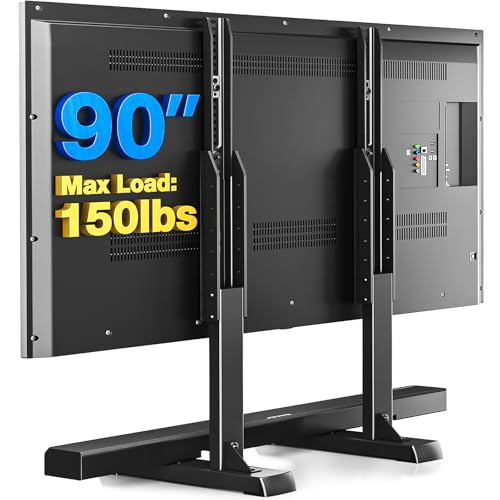 Rfiver Table Top TV Stand with Height | Our professional team designed this double T-shaped TV… Our table top TV stand is designed with… Each package includes sticky cable fasteners, which help… | Check price |
As an Amazon Associate we earn from qualifying purchases at no extra cost to you.
Quick comparison: which type fits your room?
| Stand type | Typical width | Typical weight capacity | Best for | Main compromise |
|---|---|---|---|---|
| Low media console | 70–80 inches | 100–200 lb | Large living rooms and soundbars | Uses more floor space |
| Compact console | 60–70 inches | 80–150 lb | Smaller rooms where the TV feet fit safely | Less visual stability and storage |
| Corner TV stand | 55–65 inches front width | 80–150 lb | Rooms with an unused corner | Depth can be surprisingly large |
| Open shelving unit | 65–80 inches | 100–250 lb | Game consoles, receivers, and heat-producing equipment | More visible cables and dust |
| Wall-mounted TV with low cabinet | 60–80 inches | Cabinet usually 100–200 lb | Clean appearance and flexible viewing height | Requires suitable wall structure and careful installation |
Our picks by buying situation
Best overall: a 70- to 80-inch low media console
For most 75-inch televisions, a broad low console is the safest all-round choice. Look for a top at least 70 inches wide, a depth of 16 to 20 inches, and a published top capacity of 100 pounds or more. A console slightly wider than the TV makes the arrangement look balanced and leaves room for a soundbar without crowding the screen.
Choose adjustable shelves if you use a cable box, game console, AV receiver, or streaming device. Open or slatted sections are preferable around equipment that becomes warm. Closed doors are useful for hiding controllers and discs, but they should include ventilation openings rather than forming sealed compartments.
Best for a tight budget: a reinforced open-shelf stand
Basic open shelving is often the least expensive route, commonly falling in the general market range of about $80 to $180. It can support a large television well when the frame uses a rigid steel or thick engineered-wood top and has a center support rather than a long unsupported span.
Inspect the specifications for the top load, not just the total load. A stand rated for 250 pounds in total may assign only 100 pounds to the top and the remainder to lower shelves. Avoid models that wobble when pushed from the side, particularly on hard flooring. Open shelves improve airflow but require more frequent dusting.
Best for equipment and heat management: an open media console
If your setup includes an AV receiver, gaming computer, amplifier, or several consoles, prioritize ventilation over maximum cabinet storage. A useful layout has at least 2 inches of clearance above heat-producing devices, rear cable openings, and either an open back or generous ventilation slots.
Do not place a receiver directly beneath a television’s central support if the stand’s top is not designed for concentrated weight. Spread equipment across the shelves, keep power bricks off carpet, and leave room to pull each device forward for cleaning.
Best for a small room: a narrow console or wall-mounted combination
A 60- to 70-inch console can work in a smaller room, but only if the television’s feet sit completely on the top. A 75-inch screen can overhang a stand slightly for appearance, yet the feet must not extend beyond the front or side edges. If the feet are too widely spaced, a wall mount paired with a shallow cabinet may provide a safer footprint.
Measure the viewing distance as well as the furniture. A large stand can make a room feel cramped even when it technically fits. Mark the proposed width and depth on the floor with painter’s tape for a day before ordering.
How wide and strong should the stand be?
Use this simple fit calculation:
Required top width = the wider of the TV’s total width or the distance between its feet, plus your preferred side clearance.
For example, suppose a television is 65.5 inches wide, its feet are 49 inches apart, and you want 3 inches of visible console on each side. The required width is 65.5 + 6 = 71.5 inches, so a 72-inch or wider stand is appropriate. If the feet are 68 inches apart, the foot spacing—not the screen width—becomes the controlling measurement.
For capacity, add the television’s weight to the weight of any soundbar or center speaker placed on the top. If the TV weighs 82 pounds and the speaker weighs 18 pounds, the working load is 100 pounds. Select a stand rated for at least 125 to 150 pounds to provide a sensible margin for uneven loading and everyday movement.
Features worth paying for
- Rear cable openings: Openings near both sides and the center prevent cables from crossing in front of shelves. A single small hole can be frustrating with multiple HDMI, optical, antenna, and power leads.
- Adjustable shelves: Shelves spaced in 1- to 2-inch increments accommodate tall consoles and allow airflow above them.
- Leveling feet: These are valuable on uneven floors and reduce rocking across a wide cabinet.
- Center reinforcement: A central divider, leg, or metal brace helps prevent a long top from sagging over time.
- Ventilated doors: Solid doors look tidy, but slats, mesh, or rear openings are preferable for electronics.
- Anti-tip hardware: Secure tall or lightweight furniture to a wall, especially in homes with children, pets, or frequent foot traffic.
Assembly, placement, and cable management
Assembly quality matters more than many product listings suggest. A wide stand with loose cam fittings or an under-tightened center support may develop a twist that makes the TV unstable. Assemble it on a flat surface, tighten fasteners in stages, and recheck them after the cabinet has carried its load for a week.
- Measure the TV, stand location, outlets, and viewing path before assembly.
- Build the frame without forcing misaligned panels; forced joints can split engineered wood.
- Install the back panel or braces exactly as directed because they often prevent side-to-side racking.
- Level the stand before placing the television on it.
- Route power and signal cables through separate paths where possible, using loose loops rather than sharp bends.
- Leave service slack so a device can be pulled forward without unplugging every cable.
Keep the television’s power cable from being pinched against the wall. Do not bundle hot equipment tightly against a cable-management sleeve, and avoid filling every opening with decorative baskets that block ventilation.
Durability and ownership realities
The parts most likely to cause trouble are the adjustable shelf pins, door hinges, cable grommets, thin back panels, and long unsupported tops. Heavy books or speakers can permanently bow a shelf even when the total cabinet capacity seems generous. Move heavy equipment toward the sides of a shelf only when the structure is designed for it; otherwise, keep the load near dividers or legs.
Dust can restrict ventilation, especially in open shelving near a floor. Unplug equipment before cleaning, use a dry or barely damp microfiber cloth, and keep liquid away from cable openings. For wood-look laminate, avoid abrasive cleaners and standing moisture. If a cabinet door begins rubbing, adjust its hinges rather than repeatedly forcing it shut.
Expect broad, sturdy consoles to cost roughly $180 to $500, with solid wood, metal fabrication, integrated ventilation, or premium wall-mounted cabinetry often costing more. Spending extra on structure, leveling, and cable access is generally more useful than paying for decorative trim.
Final buying checklist
- The top is at least as wide as the television, with room for the feet and soundbar.
- The stated top capacity exceeds the combined weight of the TV and anything placed beside it.
- The depth accommodates the feet without front or rear overhang.
- Heat-producing electronics have open space or ventilation.
- Cable holes align with the equipment and wall outlets.
- The stand has a center support, leveling method, and anti-tip provision where needed.
- The total footprint leaves safe walking space and does not obstruct vents, radiators, or doors.
For most buyers, a 72- to 80-inch console rated for at least 125 pounds, with adjustable ventilated storage and several rear cable openings, is the strongest match for a 75-inch TV. Smaller or cheaper stands can work, but only after checking the television’s exact foot spacing, weight, depth, and the room’s available floor area.
More from Amazon
Programs that pair well with the guide above. Offers and eligibility are set by Amazon and may change.
Free shipping on eligible items, Prime Video and more. Eligible new members can start with a free trial.
Start a Prime free trialA Prime membership for ages 18-24 with a trial period. Eligibility is set by Amazon.
See Prime for Young AdultsAudiobooks and podcasts to listen to on the go. Eligible new members can start with a free trial.
Try Audible freeAd-free music streaming. Eligible new subscribers can start with a free trial.
Try Music Unlimited freeAs an Amazon Associate we earn from qualifying purchases.







Write Your Review
No reviews yet. Be the first to share your experience!