

The best towel warmers depend on how many towels you heat, how much wall or floor space you have, and whether you want a quick burst of warmth or an appliance that can run on a schedule: choose a heated cabinet for thick, fully enclosed towels, or a wall-mounted rail for lower capacity, faster drying, and a smaller bathroom footprint.
Our top picks
 SAMEAT Heated Towel Warmers for Bathroom
- Extra Large Capacity Towel Warmer: The ultra-large Bucket…
- Heats up rapidly and 4 Timer Settings: The…
- Thermos Bucket Design: The towel warmer will heat…
 FLYHIT Large Towel Warmer for Bathroom
- Generous Capacity Warmer: This spacious bathroom essential easily…
- Experience Swift Heating: With a simple process, just…
- Safety at the Core: Safety is paramount, which…
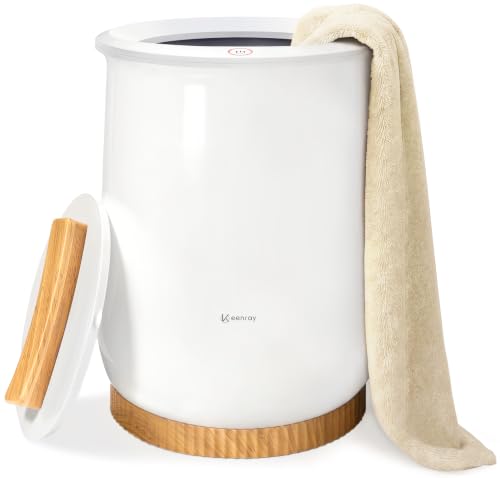 Keenray Towel Warmer
- Extra Large Capacity - Ultra large Bucket towel…
- Quickly Heating up - Offers rapid heat up…
- Heat Evenly - This bath towel warmer will…
| Product | Key specs | |
|---|---|---|
| SAMEAT Heated Towel Warmers for Bathroom | Extra Large Capacity Towel Warmer: The ultra-large Bucket… Heats up rapidly and 4 Timer Settings: The… Thermos Bucket Design: The towel warmer will heat… | Check price |
| FLYHIT Large Towel Warmer for Bathroom | Generous Capacity Warmer: This spacious bathroom essential easily… Experience Swift Heating: With a simple process, just… Safety at the Core: Safety is paramount, which… | Check price |
| Keenray Towel Warmer | Extra Large Capacity - Ultra large Bucket towel… Quickly Heating up - Offers rapid heat up… Heat Evenly - This bath towel warmer will… | Check price |
 CWDOlROI Towel Warmer | Extra Large Towel Warmer: Our towel warmers for… Quickly Heating Up and Heat Evenly: This towel… Upgraded with Smart LCD: The hot towel warmer… | Check price |
As an Amazon Associate we earn from qualifying purchases at no extra cost to you.
Cabinet vs. rail: the decision in one glance
| Design | Typical capacity | Heat-up time | Typical power | Best for | Main compromise |
|---|---|---|---|---|---|
| Compact cabinet | 1–2 bath towels or 4–8 hand towels | 15–30 minutes | 100–200 W | Warm, enclosed towels and small households | Uses counter or floor space; less effective at drying damp towels |
| Large cabinet | 2–4 bath towels or 8–16 hand towels | 20–40 minutes | 150–300 W | Families, guest bathrooms, spas, and frequent use | Heavier, larger, and usually more expensive |
| Wall-mounted heated rail | 1–2 bath towels, depending on width | 15–35 minutes | 40–150 W | Drying towels between uses and saving floor space | Only the parts touching or near the bars become warm |
| Freestanding ladder rail | 2–4 towels | 20–40 minutes | 60–150 W | Renters or bathrooms without suitable wall wiring | Occupies floor area and can be easier to knock over |
These are normal product-category ranges rather than guarantees for every model. Actual performance varies with towel thickness, room temperature, spacing between towels, insulation, and whether the unit is intended to warm or dry.
Best towel warmer by bathroom situation
- For one or two people in a small bathroom: Choose a compact cabinet holding one bath towel or several hand towels. It gives more consistent all-over warmth than a short rail without requiring wall installation.
- For a family or shared bathroom: Choose a wide, multi-bar rail or a large cabinet. A rail is usually the better long-term option if towels need to dry between showers; a cabinet is better when several people want warm towels at the same time.
- For renters: A freestanding rail or countertop cabinet avoids permanent mounting. Check its base width and cable position before buying, because a narrow vanity can leave little safe clearance.
- For a luxury or spa-style bathroom: A hardwired wall rail offers the cleanest appearance and can be connected to a timer or bathroom lighting circuit by a qualified electrician.
- For occasional guests: A small cabinet with a 30- or 60-minute timer avoids leaving a high-capacity appliance operating unnecessarily.
- For frequent towel washing and drying: Favor a rail. Air can circulate around a hanging towel, while a cabinet may warm a damp towel without removing moisture efficiently.
What separates the best models
Capacity and usable space
Manufacturers often describe capacity by towel count, but towel dimensions are more useful. A standard bath towel is commonly about 27–30 inches wide and 50–58 inches long (69–76 by 127–147 cm). A cabinet with an interior around 12 inches wide, 10 inches deep, and 12 inches high is generally suited to folded hand towels or one tightly folded bath towel, not two thick bath sheets.
Rails are easier to compare by heated width and bar spacing. A rail around 20–24 inches wide can accommodate one bath towel folded over it. For two towels, look for at least 24–32 inches of width, multiple horizontal bars, and enough vertical separation to prevent a dense folded bundle from blocking airflow.
Heat-up time and towel temperature
A cabinet normally warms the enclosed air first, then transfers heat into the towel. Thin towels may feel warm after 10–15 minutes, while thick cotton towels can need 25–40 minutes. Rails often feel warm on the bar within 10–20 minutes, but the towel itself may take longer because only sections of fabric touch the heated surface.
Do not judge a warmer by the highest advertised surface temperature alone. Even heating, a stable thermostat, and a timer are more useful than an extremely hot bar or interior. Excessive heat can degrade some synthetic fibers and may make a towel uncomfortable rather than pleasantly warm.
Timer controls
A basic on/off switch is adequate only if you are willing to monitor it. The most useful controls are a 30-, 60-, or 120-minute shutoff, plus a delayed-start or daily scheduling function. A timer prevents wasted electricity and reduces the chance that the unit remains warm for hours after use.
For a cabinet, an interior light or transparent door is convenient but not essential. For a rail, a visible power indicator and a switch positioned away from splash zones are more important. Avoid assuming that a bathroom-rated appliance can be installed inside a shower enclosure; follow the manufacturer’s location and electrical instructions.
Moisture resistance and construction
Bathrooms are humid, but not every towel warmer is designed for direct splashing. Look for a stated moisture-resistance rating, sealed controls, corrosion-resistant stainless steel or powder-coated metal, and a power cord with strain relief. “Rustproof” marketing is less informative than the actual material and installation instructions.
A cabinet should have a removable or washable interior tray to catch condensation and lint. A rail should have smooth welds and no exposed crevices around the bars, where mineral deposits and soap residue can collect. Hardwired models need suitable bathroom electrical protection and professional installation where local rules require it.
Energy use: a practical cost calculation
Electricity consumption is easy to estimate: watts divided by 1,000, multiplied by operating hours and your electricity rate. For example, a 120-watt rail used for 45 minutes per day consumes:
0.120 kW × 0.75 hours × 365 days = 32.85 kWh per year.
At an illustrative electricity price of $0.20 per kWh, that is about $6.57 per year. A 200-watt cabinet used for 60 minutes daily consumes 73 kWh annually, or about $14.60 per year at the same rate. Actual costs depend on local electricity prices and whether the thermostat cycles the heater rather than running continuously.
The largest energy mistake is choosing a large cabinet and leaving it on all day. A scheduled 30- to 60-minute cycle usually provides the useful warmth without paying for idle operation. A rail may use less power overall, but it can require more time to warm a thick towel.
Ownership realities: what wears out first
- Switches and timer buttons: These receive repeated handling and may become intermittent before the heating element fails. A simple, replaceable-looking control is preferable to an overly complex touch panel in a humid room.
- Door seals and hinges: Cabinet gaskets collect lint and moisture. Wipe them regularly and avoid overfilling the interior, which strains hinges and prevents even heating.
- Surface finish: Cheap plating can discolor or pit where water droplets remain. Dry the exterior and choose stainless steel or a well-finished coating for wet environments.
- Heating elements: They generally last longer when the unit has a thermostat and is not covered, overloaded, or operated in a location outside its specified temperature and moisture range.
- Lint and residue: Fabric softener, detergent residue, and lint can build up inside cabinets. Do not spray cleaner into vents or controls; unplug the appliance and use a lightly damp cloth instead.
Safe setup and maintenance
- Measure first. Record the available width, depth, height, outlet location, and door or shower clearance. Leave the ventilation clearance specified by the manufacturer.
- Match the electrical supply. Check voltage, plug type, wattage, and whether the bathroom circuit has appropriate protection. Never use a damaged extension cord in a humid area.
- Install or place it away from direct spray. A towel warmer can operate in a bathroom without being suitable for a shower wall or bath edge.
- Use clean, damp—not dripping—towels. A saturated towel adds unnecessary moisture and may make a cabinet smell musty.
- Load loosely. Fold towels into a cabinet without compressing every gap. On rails, spread fabric across the bars rather than creating a thick roll.
- Clean monthly, or more often in a busy bathroom. Unplug the unit, remove lint, wipe surfaces, and inspect the cord, mounting points, seals, and finish before reconnecting it.
Bottom line
The best towel warmers for most small bathrooms are compact cabinets when the priority is a reliably warm, enclosed towel. Choose a heated rail when drying performance, low energy use, and minimal floor space matter more. Before buying, compare the actual towel dimensions the unit can accept, its timed operating modes, stated moisture resistance, wattage, and cleaning access—not merely the number of towels printed on the box.
More from Amazon
Programs that pair well with the guide above. Offers and eligibility are set by Amazon and may change.
Free shipping on eligible items, Prime Video and more. Eligible new members can start with a free trial.
Start a Prime free trialA Prime membership for ages 18-24 with a trial period. Eligibility is set by Amazon.
See Prime for Young AdultsAudiobooks and podcasts to listen to on the go. Eligible new members can start with a free trial.
Try Audible freeAd-free music streaming. Eligible new subscribers can start with a free trial.
Try Music Unlimited freeAs an Amazon Associate we earn from qualifying purchases.






Write Your Review
No reviews yet. Be the first to share your experience!