

The best betta fish tanks are usually 5 to 10 gallons, with a secure lid, adjustable gentle filtration, and a reliable heater; a 5-gallon tank is the best all-around choice for most single bettas.
Our top picks
 Tetra LED Half Moon 1.1 Gallon Fish
- Clear plastic, half-moon-shaped front allows for unobstructed viewing.
- Bettas require minimal maintenance and make great species…
- Energy-efficient LEDs can be positioned to light tank…
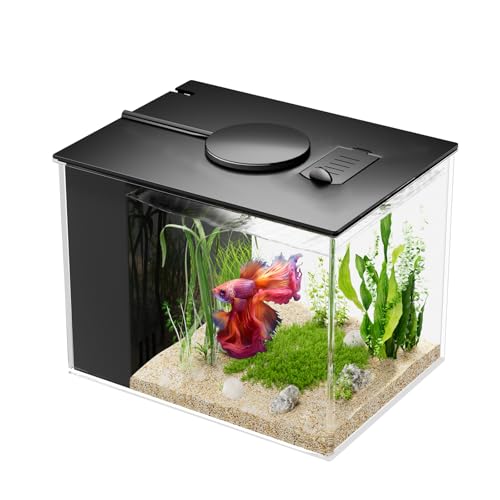 Vehipa Betta Fish Tank 1 Gal
- Perfect Mini Habitat: Measuring just 7.8"L x 5.8"W…
- Vibrant 3-Color LED Lighting: Illuminate your underwater world…
- Discreet & Silent Filtration: A concealed filter pump…
| Product | Key specs | |
|---|---|---|
| Tetra LED Half Moon 1.1 Gallon Fish | Clear plastic, half-moon-shaped front allows for unobstructed viewing. Bettas require minimal maintenance and make great species… Energy-efficient LEDs can be positioned to light tank… | Check price |
| Vehipa Betta Fish Tank 1 Gal | Perfect Mini Habitat: Measuring just 7.8"L x 5.8"W… Vibrant 3-Color LED Lighting: Illuminate your underwater world… Discreet & Silent Filtration: A concealed filter pump… | Check price |
 AQUANEAT Fish Tank | Check price | |
 Juilsioa Betta Fish Tank 1.6 Gallon Glass | Starter Desktop Aquarium:Dimensions: 7.9"L × 5.9"W × 9.6"H.This… Self Circulating Filtration System: Our water pump integrates… Ultra-Clear Glass Construction: The small fish tank is… | Check price |
As an Amazon Associate we earn from qualifying purchases at no extra cost to you.
Quick picks by situation
| Situation | Best choice | Why it fits | Trade-off |
|---|---|---|---|
| Most beginners | 5-gallon rectangular kit | Stable water volume, manageable footprint, usually includes a light and filter | Included equipment may need adjustment or replacement |
| Very limited desk space | 3-gallon rectangular tank | More practical than a bowl and easier to place than a larger aquarium | Water quality and temperature change faster; maintenance must be consistent |
| Best long-term environment | 10-gallon rectangular tank | More swimming room and greater tolerance for small maintenance errors | Heavier, wider, and more expensive to equip |
| Quiet room or bedroom | 5- to 10-gallon tank with adjustable internal or sponge filtration | Flow can be slowed to prevent fin stress and excessive surface disturbance | Sponge filters need an air pump and take up visible space |
| Display-focused setup | Rimmed glass tank with a separate lid and light | Flexible layout, easier access, and clearer control over each component | Usually costs more than an all-in-one kit |
What to look for in the best betta fish tanks
Volume and shape
Choose at least 5 gallons when space and budget allow. A 5-gallon tank provides enough water for a filter and heater while remaining relatively easy to move and clean. A 10-gallon tank is even more forgiving: waste is diluted in a larger volume, temperature changes are slower, and there is room for plants, shelter, and open swimming space.
A 3-gallon tank can work as a space-constrained compromise, but it requires closer attention to evaporation, temperature, and water testing. Bowls and decorative containers are poor choices because they provide little room for equipment, have unstable temperatures, and often lack a secure lid.
Rectangular tanks are generally more useful than tall, narrow designs. Bettas need access to the surface, and a long horizontal footprint creates swimming space without making the fish travel far upward for air. Avoid unusually deep tanks if the betta must struggle to reach the surface.
Filtration: gentle flow matters more than maximum power
A filter removes suspended debris and provides biological filtration, but a betta should not have to fight a strong current. Look for an adjustable filter, a flow-control valve, a spray bar, or an outlet that can be aimed at the glass. A pre-filter sponge over an intake also helps protect long fins and small fish.
Hang-on-back filters can work well on 5- and 10-gallon tanks if their flow is reduced. Internal filters save space around the tank but may create a concentrated jet. Air-driven sponge filters are gentle and effective, although they require an air pump, airline tubing, and a check valve.
Do not replace all filter media at once. Rinse reusable media in removed aquarium water, not untreated tap water, so beneficial bacteria are less likely to be disrupted. Replace disposable carbon cartridges only when they are exhausted or damaged; routine cartridge replacement can remove useful biological media and increase running costs.
Heating and temperature control
A betta setup normally needs a thermostatically controlled heater, especially in rooms below the aquarium’s target range. Aim for approximately 25–27°C (77–81°F), with stability more important than chasing an exact number. Use a separate aquarium thermometer rather than relying only on the heater’s dial.
For sizing, a rough starting point is 5 watts per gallon in a moderately warm room, but room temperature, tank lid, and seasonal conditions matter. A 25-watt adjustable heater is commonly suitable for a 5-gallon tank, while a 50-watt model is often appropriate for a 10-gallon tank. Follow the heater manufacturer’s rated range and use a guard if the design permits one.
Never run a heater out of water. Unplug it before lowering the water level or performing a water change, and allow it to cool according to the manufacturer’s instructions before removal.
Lids, gaps, and evaporation
Bettas can jump, so a tight-fitting lid is essential. Check for gaps around filter cables, heater cords, and airline tubing. A glass or polycarbonate lid with cable cutouts is usually more secure than an open-top arrangement.
A lid also slows evaporation and reduces temperature swings. It does not eliminate evaporation, however: top off with suitable treated water when needed, but remember that topping off replaces water volume without removing accumulated nitrate. Regular partial water changes are still necessary.
Head-to-head: 5 gallons versus 10 gallons
| Factor | 5-gallon tank | 10-gallon tank |
|---|---|---|
| Typical empty tank weight | About 7–10 lb (3–4.5 kg) | About 15–20 lb (7–9 kg) |
| Approximate filled weight | About 55–70 lb including glass, gravel, and equipment | About 110–130 lb including glass, gravel, and equipment |
| Common footprint | Roughly 16–20 in long by 8–12 in deep | Roughly 20–24 in long by 10–12 in deep |
| Temperature stability | Good with a lid and correctly sized heater | Very good; slower to change |
| Maintenance water change | About 1–1.5 gallons for a 20–30% change | About 2–3 gallons for a 20–30% change |
| Typical equipment budget | About $80–$180 before livestock and supplies | About $120–$260 before livestock and supplies |
The weight calculation is important. A filled 10-gallon aquarium should sit on a level, purpose-built aquarium stand or a surface specifically rated for the load. A bookshelf or desk that feels sturdy may not distribute weight correctly across the tank’s base.
Tank styles worth considering
All-in-one kits
All-in-one kits, including products such as the Fluval Spec V and various 5-gallon kits from Aqueon or Marina, simplify shopping by combining a tank, light, and filtration. They are convenient for first-time owners, but inspect the filter outlet before buying: an attractive kit is not a good choice if the flow cannot be reduced for a betta.
Standard rimmed glass tanks
A standard 5- or 10-gallon glass aquarium gives you the most control over filtration, lighting, heating, and hardscape. It is often the best value over several years because individual components can be replaced instead of discarding an entire integrated system. The downside is that you must buy and match every component yourself.
Acrylic tanks
Acrylic is lighter and less likely to shatter, which can help in some rooms. It scratches more easily than glass, so use acrylic-safe cleaning tools and never scrub algae with a rough pad. Check that the lid fits securely and that the base is supported as specified by the manufacturer.
Safe layout: build around surface access
- Leave an unobstructed route to the surface, especially near the front or a quiet corner.
- Use smooth decorations without sharp edges that can catch fins.
- Choose live plants or aquarium-safe silk plants; avoid stiff plastic plants with pointed leaves.
- Anchor lightweight plants and ornaments so they cannot fall against the heater.
- Keep the strongest filter flow away from resting areas.
- Use a thin layer of gravel or sand rather than an excessively deep substrate that traps debris.
- Provide cover, but retain an open swimming area instead of filling the entire tank with decorations.
A simple 5-gallon layout might use approximately 5–8 lb of rinsed substrate, one small hide, a plant cluster on one side, and open water on the other. This arrangement creates shelter without blocking maintenance access or the heater’s circulation.
Maintenance realities that affect ownership
Before adding a betta, cycle the aquarium so beneficial bacteria can process fish waste. Test ammonia and nitrite during cycling and after adding the fish. Once established, perform a partial water change of roughly 20–30% as needed, commonly weekly, while adjusting the schedule according to test results, stocking, feeding, and plant growth.
Use a gravel vacuum that fits the tank’s footprint. For a 5-gallon tank, removing 1–1.5 gallons during a routine change is usually more manageable than draining a large portion. Match new water temperature as closely as practical, treat it with a suitable water conditioner, and avoid washing tank equipment with soap.
The parts most likely to wear first are filter impellers, intake sponges, airline tubing, heater seals, and inexpensive LED power supplies. Keep replacement media and a spare thermometer available. A heater failure is especially difficult to notice without a thermometer, while a clogged intake can reduce filtration before the water looks cloudy.
Bottom line
For most owners, select a rectangular 5-gallon tank with a secure lid, a 25-watt adjustable heater, a thermometer, and filtration that can be slowed to a gentle flow. Choose 10 gallons if you have the floor space and a properly rated stand; it offers the easiest water stability and the most flexible layout. Choose 3 gallons only when space leaves no practical alternative, and compensate with careful testing, stable heating, and consistent maintenance.
More from Amazon
Programs that pair well with the guide above. Offers and eligibility are set by Amazon and may change.
Free shipping on eligible items, Prime Video and more. Eligible new members can start with a free trial.
Start a Prime free trialA Prime membership for ages 18-24 with a trial period. Eligibility is set by Amazon.
See Prime for Young AdultsAudiobooks and podcasts to listen to on the go. Eligible new members can start with a free trial.
Try Audible freeAd-free music streaming. Eligible new subscribers can start with a free trial.
Try Music Unlimited freeAs an Amazon Associate we earn from qualifying purchases.










Write Your Review
No reviews yet. Be the first to share your experience!