

Best Rolling Duffel Bags for Easy Travel
The best rolling duffel bags are the ones that match your trip length and airline rules: choose a compact 40–45L carry-on for frequent flights, a 70–90L model for checked luggage, and a reinforced 100L-plus bag only when maximum capacity matters more than weight and handling.
Rolling duffels combine the soft-sided packing space of a duffel with wheels and a telescoping handle. That sounds convenient, but the trade-offs are important. A large bag may hold more than a traditional suitcase while weighing less; it may also lack rigid protection, roll poorly over rough ground, or exceed an airline’s checked-bag dimensions. The right choice depends on usable capacity, empty weight, wheel construction, handle strength, and how the compartments support your packing style.
Our top picks
 Wrangler Wesley Rolling Duffel Bag
- Authentic Wrangler: Officially branded product known for quality…
- Check-In Size (30"): Travel-friendly design meets check-in suitcase…
- Durable Nylon: Lightweight yet robust, perfect for frequent…
 Finnhomy 120L Foldable Rolling Duffel Bag with
- Heavy Duty Wheels & Strenthened Bottom
- Different Ways to Carry
- Foldable Design
 Amazon Basics 35-Inch Large Rolling Duffel Bag
- Top crafted from 100% polyester, this large duffel…
- Equipped with a telescopic handle and in-line wheels,…
- Featuring multiple zippered compartments, the rolling luggage offers…
| Product | Key specs | |
|---|---|---|
| Wrangler Wesley Rolling Duffel Bag | Authentic Wrangler: Officially branded product known for quality… Check-In Size (30"): Travel-friendly design meets check-in suitcase… Durable Nylon: Lightweight yet robust, perfect for frequent… | Check price |
| Finnhomy 120L Foldable Rolling Duffel Bag with | Heavy Duty Wheels & Strenthened Bottom Different Ways to Carry Foldable Design | Check price |
| Amazon Basics 35-Inch Large Rolling Duffel Bag | Top crafted from 100% polyester, this large duffel… Equipped with a telescopic handle and in-line wheels,… Featuring multiple zippered compartments, the rolling luggage offers… | Check price |
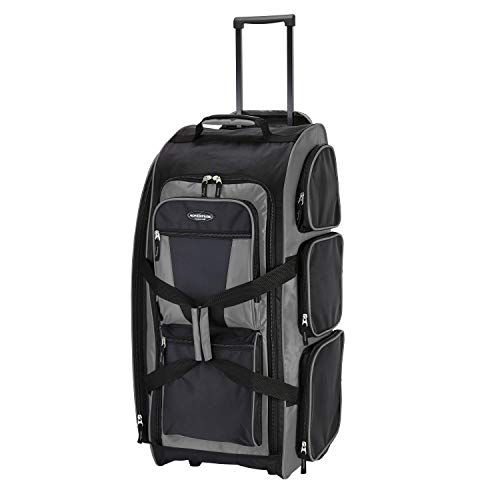 Travelers Club 30" Xpedition Rolling Duffel Bag | Extra-Large 77L Rolling Luggage Capacity: Oversized 30” rolling… Upright Rolling Suitcase Design for Easy Travel: Vertical… Multi-Pocket Travel Organization: Large main compartment plus multiple… | Check price |
As an Amazon Associate we earn from qualifying purchases at no extra cost to you.
Quick comparison of strong rolling-duffel choices
| Bag or type | Approx. capacity | Approx. empty weight | Best use | Important limitation |
|---|---|---|---|---|
| Travelpro Bold 2.0 Rolling Duffel, 30-inch | About 100–110L | About 10–11 lb | Frequent checked-airline travel | Large exterior dimensions can approach or exceed some airline limits |
| Patagonia Black Hole Wheeled Duffel, 70L | 70L | About 8 lb | Active trips and mixed surfaces | Less structured than a conventional suitcase |
| The North Face Base Camp Voyager Roller, 29-inch | Roughly 90–100L, depending on version | About 9–10 lb | Long trips with outdoor gear | Confirm current dimensions before checking it |
| Medium rolling duffel, 24–26-inch class | 65–85L | 7–10 lb | One to two weeks of ordinary clothing | Less room for bulky boots or technical equipment |
| Carry-on rolling duffel, 20–22-inch class | 35–50L | 5–8 lb | Short trips and avoiding checked-bag fees | Soft sides can bulge beyond the stated depth |
Dimensions and weights can vary by production year, fabric, and retailer configuration. Treat the figures above as buying ranges, then verify the manufacturer’s current specification before purchasing or flying.
Best rolling duffel bags by travel situation
Best for frequent airline travel: a 24–26-inch, two-wheel model
A medium rolling duffel is the most balanced choice for travelers who check luggage regularly. Look for a bag with a reinforced wheel housing, a metal or thick composite telescoping handle, and a total exterior measurement near or below 62 linear inches. Airlines commonly use 62 linear inches as the standard checked-bag size, calculated by adding length, width, and height, but individual carriers can apply different rules.
Two wheels usually leave more internal space than four spinner wheels because the wheel assemblies occupy less of the bag. The compromise is that the bag must be tilted while moving. For airports, sidewalks, and hotel corridors, that is usually manageable and often more durable than small spinner casters.
Best for outdoor equipment: Patagonia Black Hole Wheeled Duffel 70L
The Patagonia Black Hole Wheeled Duffel 70L is a sensible middle ground for fishing trips, camping weekends, and travel involving wet-weather layers. Its weather-resistant recycled fabric and relatively compact capacity make it easier to control than a huge expedition bag. The main compartment handles clothing and soft equipment, while exterior or end storage can separate footwear and small accessories.
This type of bag is especially useful when the contents are irregularly shaped. A soft duffel can accommodate waders, rain gear, or a rolled jacket more efficiently than a rigid suitcase. It does not, however, protect fragile equipment as well as a hard case. Use padded sleeves or separate boxes for reels, cameras, electronics, and tackle.
Best for maximum capacity: a 90–110L large rolling duffel
A large model such as the 30-inch Travelpro Bold 2.0 Rolling Duffel is appropriate for extended travel, multiple people sharing one bag, or bulky cold-weather clothing. Its advantage is volume: a high-capacity duffel can swallow coats and soft equipment without the wasted corners found in many hard-sided cases.
The danger is filling it simply because space is available. A 100L bag filled with dense gear can become difficult to lift and may exceed a 50-pound airline weight limit. Large bags are also more likely to be oversize. Measure the packed bag, not just the empty bag, because soft walls expand.
Best for rough handling: a reinforced outdoor rolling duffel
The North Face Base Camp Voyager Roller and similar outdoor-oriented bags suit travelers who move between vehicles, lodges, docks, and unpaved paths. Prioritize large wheels, protected wheel mounts, abrasion-resistant fabric, and compression straps over a long list of pockets. Larger wheels roll over gravel and thresholds more effectively than small suitcase casters.
Remember that “water-resistant” is not the same as waterproof. A coated fabric may resist rain during a transfer, but it should not be treated as a dry bag. Place clothing and electronics in waterproof inner bags, particularly when transporting fishing equipment or traveling by boat.
How to compare capacity without being misled
Advertised liters describe the approximate internal volume, not the amount of convenient packing space. Wheel wells, handle channels, curved ends, thick padding, and permanently installed dividers reduce usable capacity. A 70L rolling duffel with a straight rectangular main compartment may pack more practically than a nominally larger bag with bulky hardware.
A useful packing estimate is:
- 35–50L: two to five days of ordinary clothing, depending on shoes and outerwear.
- 60–75L: about one week of clothing, or a shorter trip with boots and outdoor layers.
- 90–110L: extended travel, shared packing, or bulky cold-weather equipment.
For example, if your clothing and personal items occupy about 45L and your boots, rain shell, and equipment require another 15L, a 70L bag offers approximately 10L of working space. That buffer matters: packing to the absolute limit makes zippers harder to close and increases stress on seams.
Wheel and handle durability: what to inspect
- Wheel size: Wheels around 70–80 mm generally cope better with pavement cracks and thresholds than very small casters.
- Wheel protection: Recessed wheels survive conveyor belts better than exposed wheels, although the housing can reduce internal space.
- Wheel replacement: Check whether the manufacturer sells replacement wheels or offers repair service. A worn wheel should not automatically end the life of the bag.
- Handle play: Extend the handle fully and move it side to side. A small amount of movement is normal; pronounced wobble suggests a weak rail or loose mounting.
- Base reinforcement: Inspect the bottom corners and the fabric around the wheel mounts. These areas receive repeated impact and abrasion.
- Zippers and pulls: Large, repairable zipper pulls are easier to use with cold or wet hands. Do not overstuff a zipper until the teeth are under constant tension.
Two-wheel designs are typically simpler and leave more room inside. Four-wheel spinners are easier to maneuver beside you, but their small, outward-facing casters can be vulnerable on gravel, curbs, and baggage conveyors. Choose spinners mainly for smooth indoor surfaces.
Airline fit and empty weight
For checked luggage, add the bag’s length, width, and height. A bag measuring 30 by 15 by 14 inches totals 59 linear inches and is likely to fit the common 62-inch standard, although an expanded or overpacked bag could exceed it. A 32 by 16 by 15-inch bag totals 63 inches before expansion and deserves extra scrutiny.
For carry-on use, many airlines publish a limit close to 22 by 14 by 9 inches, but limits differ, and soft-sided bags can bulge. A nominally 22-inch rolling duffel may not fit a sizer when full. If avoiding checked baggage is your priority, choose a bag with an unexpanded depth comfortably below the limit and pack it without forcing the zipper.
Empty weight also affects usable capacity. Suppose an airline allows 50 pounds and your duffel weighs 9 pounds empty. Your contents can weigh only 41 pounds. A lighter 6-pound bag gives back three pounds—enough for shoes, a rain jacket, or several days of clothing—provided it does not sacrifice wheel and handle strength.
Compartment layouts that work in practice
The most useful layout is usually a large central compartment, a separated shoe or end compartment, and one accessible exterior pocket. Too many small pockets reduce the main packing area and make bulky items harder to place. A full-length opening is better than a narrow top opening when the bag will hold boots, waders, or folded equipment.
Keep dense items low and close to the wheel end, then place soft clothing above them. Use the end compartment for footwear, toiletries in sealed bags, or dirty clothing. Avoid putting fragile gear against the exterior panels, where conveyor impacts are most likely.
Ownership costs and maintenance
Entry-level rolling duffels commonly cost roughly $70–$150, mid-range outdoor and travel models about $150–$300, and premium reinforced bags $300 or more. The cheapest option can be economical for occasional use, but frequent travelers should compare repairability rather than just purchase price.
If a $240 bag lasts 60 trips, its bag cost is about $4 per trip before repairs. A $90 bag that lasts 15 trips costs $6 per trip. That calculation is imperfect, but it highlights why replaceable wheels, strong handles, and a useful warranty can matter more than a low initial price.
After each trip, empty the bag, shake out grit, and wipe the wheels and base with a damp cloth. Let wet gear dry before closing the bag. Do not machine-wash a wheeled duffel unless the manufacturer specifically permits it; water can remain around wheel housings and handle rails. Store it partly open in a dry place, and inspect the wheel screws, zipper stitching, and bottom corners before the next trip.
Bottom line
For most travelers, a 24–26-inch two-wheel rolling duffel offers the best balance of capacity, durability, and airline compatibility. Choose a 70L outdoor model when you need weather-resistant fabric and irregular packing space, a 90–110L bag for bulky or shared luggage, and a compact carry-on model only after checking its packed dimensions against your airline’s current limits. The best rolling duffel bags are not necessarily the largest; they are the ones that leave enough capacity for your gear without making the wheels, handle, or airline allowance the weak point.
More from Amazon
Programs that pair well with the guide above. Offers and eligibility are set by Amazon and may change.
Free shipping on eligible items, Prime Video and more. Eligible new members can start with a free trial.
Start a Prime free trialA Prime membership for ages 18-24 with a trial period. Eligibility is set by Amazon.
See Prime for Young AdultsAudiobooks and podcasts to listen to on the go. Eligible new members can start with a free trial.
Try Audible freeAd-free music streaming. Eligible new subscribers can start with a free trial.
Try Music Unlimited freeAs an Amazon Associate we earn from qualifying purchases.






Write Your Review
No reviews yet. Be the first to share your experience!