

Key takeaways
- Victorinox vs Dexter-Russell fillet knife: general differences in handles, flexibility, lines and upkeep, plus who each suits and what to confirm first.
Victorinox and Dexter-Russell make fillet knives that are common sights in fish markets and seafood kitchens, and both are sensible buys, so the better choice usually comes down to handle feel, blade flex and the specific line rather than the brand name. Victorinox is a Swiss company best known for its Fibrox Pro handle, while Dexter-Russell is a long-established American maker with several lines that include polypropylene and traditional wood handles. This comparison sticks to widely known, general differences and flags where you should check current specifications, since models and materials change over time.
Short verdict
If you want a familiar, ergonomic grip that is easy to keep clean and you prefer a knife that looks and feels the same from one length to the next, Victorinox is often where people start. If you want a choice among handle styles, including traditional looks and food-service lines, Dexter-Russell tends to offer more variety.
In practice, either can be an excellent working knife. The most useful step is to pick the blade length and flexibility for your fish and then compare handle comfort in the line you are considering. Confirm the details on the manufacturer’s current product pages before you buy.
Side-by-side overview
| Aspect | Victorinox | Dexter-Russell |
|---|---|---|
| Origin | Switzerland | United States |
| Best-known handle styles | Textured, non-slip Fibrox-style handle | Polypropylene Sani-Safe style and traditional wood options |
| Blade lengths | Commonly offered in several lengths | Commonly offered in several lengths |
| Blade flex | Varies by model | Varies by model |
| Food-service use | Widely used | Widely used |
| Range of lines | Fewer, simpler choices | More lines with different handle and price levels |
| Care | Hand wash and dry | Hand wash and dry, extra care for wood |
Treat the table as a starting point for questions to check against current listings, not as a specification sheet.
Handles and grip
Handle comfort matters more than most buyers expect, because fish work is wet and slippery. Victorinox is closely associated with a textured, slip-resistant handle shape that sits comfortably in different hand sizes. Many users like how it keeps its grip when covered in scales or water.
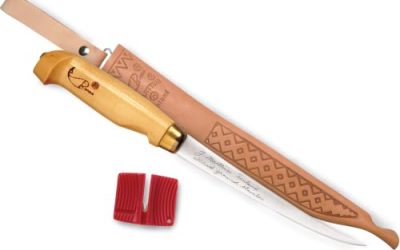
Dexter-Russell sells knives with polypropylene handles aimed at food service, which are also designed for a dependable grip and easy cleaning. It also sells traditional lines with wooden handles that appeal to people who prefer a classic look and feel, though wood generally needs more care and should not be left soaking.
If you have large or small hands, visit a store or look at published handle dimensions where available. Differences of a few millimetres can be noticeable over a long cleaning session.
Blade shape, flex and length
Both brands cover the usual fillet range from short blades for small fish through to longer lengths for salmon and similar sized catches. A general rule applies to both: longer and thinner blades are more flexible, which helps them follow the backbone and slide beneath skin, while shorter or stiffer blades give more control for small, delicate fish.
Because flexibility varies by model, ignore the brand name and read the description for words such as flexible, semi-flexible or stiff. If the listing shows blade thickness or a flex rating, compare that across the options you are considering.
Think about the fish you handle most. A knife that is a good match for pan-sized trout may feel too short for a large fillet, while a long flexible blade can feel awkward on very small fish.
Lines, certification and intended use
Both companies sell into commercial kitchens, so you will see references to food-service certification and sanitary design. These features matter if you work in a shop or cook for others, since easy cleaning and non-porous handles are part of the appeal. For home use they are a bonus rather than a requirement.
Because each maker offers multiple lines, never assume a feature applies across the whole brand. Check whether the line you want carries the certification you care about, which steel it uses and whether the handle is molded or assembled with rivets. Product specifications can change, so confirm them on the current listing.
Care, sharpening and longevity
Both brands generally supply stainless-steel blades that are easier to look after than carbon steel in damp conditions. That does not make them immune to corrosion, especially around saltwater. Rinse with fresh water after use, wash with mild soap, dry the blade and handle completely, and store the knife where it will not bang against other tools.
For sharpening, a honing steel keeps the edge aligned between sessions, and a stone or guided sharpener restores it when it is properly dull. Thin fillet blades have little metal to spare, so use light pressure and keep the angle low and consistent. Avoid the dishwasher, which can dull the edge and harm handles.
Worked example: choosing for three kitchens
The following scenarios use assumptions, not measurements, to show how the decision tends to go.
- Home cook preparing salmon fillets a few times a month: assume a long, flexible blade and a comfortable wet-hand grip are the priorities. Either brand can fit, so the tiebreaker is how the handle feels in your hand.
- Angler cleaning panfish after weekend trips: assume a short flexible blade and easy cleanup. Compare the shortest blade lengths from both brands, and favour the handle that stays secure when slippery.
- Small seafood counter filleting daily: assume the need is for a sanitary, easy-clean design that can be replaced without fuss. Check certification and line availability on both brands, and buy a few knives of the same model so they handle identically.
Common misconceptions
A higher price means a sharper knife. Edge quality depends on grinding, steel and how you maintain it; a modest knife kept honed can outcut a neglected expensive one.
A flexible blade is always better. Flex helps on long fillets but can wander on firm fish, so match the blade to the job instead.
Commercial means indestructible. Food-service knives are built for daily use, yet thin blades still bend or chip if twisted, dropped or used to pry bones.
What to check before buying
Write down the fish you plan to fillet and the blade length it suggests. Look for the exact model name, then compare flexibility, handle material, certification and warranty terms. Look at replacement and sharpening support, and make sure you have a sheath or protective guard for storage and transport. Confirm all of this on current manufacturer pages, since lines and materials change.
Finally, consider how the knife will be cleaned. If you cannot dry it right away, a moisture-friendly handle matters more. For safety, always cut away from your hand, keep a cloth under the board to prevent slipping and use a cut-resistant glove on the holding hand if you are new to filleting.
Related guides
- How Long Does Vacuum Sealed Fish Last In The Freezer
- Seafood Crackers And Crab Tool Sets
- How To Fillet A Salmon Step By Step
Frequently asked questions
Are Victorinox and Dexter-Russell both used in professional kitchens?
Yes, both names are widely associated with commercial kitchens, fish counters and food-service work. They are commonly chosen for practical features such as non-slip handles, easy cleaning and food-service sanitation listings. Because each brand sells several lines, confirm the certification and handle material of the exact model you are considering rather than assuming every knife in a range is identical.
Which brand has the more flexible fillet blade?
Flexibility depends on the specific model and blade length rather than on the brand alone, and both companies offer fillet knives in different degrees of flex. As a general rule, longer and thinner blades bend more, which helps when following the backbone of a fish. Check the product description for terms such as flexible, semi-flexible or stiff before you decide.
Do these knives need a special sharpening method?
No special method is usually required. Both brands typically make stainless-steel blades that respond to a honing steel for regular touch-ups and a stone or guided sharpener when the edge is properly dull. Thin fillet blades are delicate, so use light pressure and a low angle, and follow the maker’s care instructions. Avoid grinding aggressively, which can remove metal and change the blade’s shape.
Is it safe to put a fillet knife in the dishwasher?
It is generally not recommended. Detergents, heat and knocking against other items can dull edges and damage handles, even on knives marketed as commercial or dishwasher tolerant. Hand washing with mild soap, a quick rinse and thorough drying is the safer routine. Check the manufacturer’s care guidance, especially for wooden handles, which are usually more sensitive to water.
Is one brand better for saltwater fish?
Neither brand is automatically better. Corrosion behaviour depends on the steel used, the finish and how well the knife is cleaned and dried after use. Rinsing with fresh water, drying immediately and storing the knife dry matter more than the logo on the blade. For heavy saltwater use, check each model’s specifications for corrosion resistance and recommended applications.
More from Amazon
Programs that pair well with the guide above. Offers and eligibility are set by Amazon and may change.
Free shipping on eligible items, Prime Video and more. Eligible new members can start with a free trial.
Start a Prime free trialA Prime membership for ages 18-24 with a trial period. Eligibility is set by Amazon.
See Prime for Young AdultsAudiobooks and podcasts to listen to on the go. Eligible new members can start with a free trial.
Try Audible freeAd-free music streaming. Eligible new subscribers can start with a free trial.
Try Music Unlimited freeAs an Amazon Associate we earn from qualifying purchases.
Write Your Review
No reviews yet. Be the first to share your experience!