

Best Vertical Climbers for Home Workouts
The best vertical climbers for home workouts are the MaxiClimber Classic for small budgets and storage, the MaxiClimber XL for a more substantial home unit, and the VersaClimber for frequent, high-intensity training when commercial-grade durability matters more than price or footprint.
Vertical climbers imitate climbing by combining arm pulls with alternating leg drives. They can deliver a demanding full-body workout in a short session, but the machines differ considerably in stability, resistance, adjustability, noise, and how much room they need above and around the frame. The right choice depends less on the word “climber” and more on your ceiling height, training experience, and willingness to maintain moving parts.
Our top picks
 Relife Stair Stepper
- Equipped with Four Metal Guide Rails and included…
- Featuring 5 adjustable levels Adjustable to suit different…
- Featuring a radian design, this stair climber's pedals…
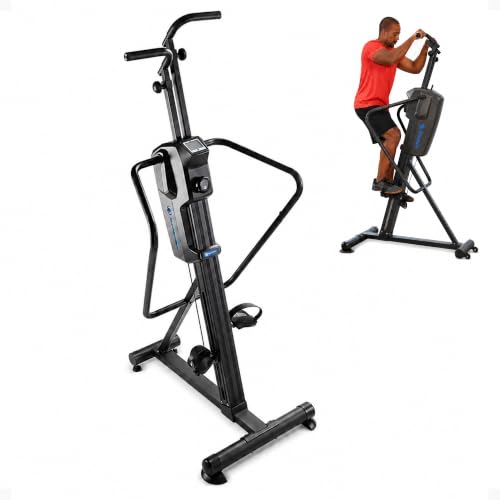 Stamina Cardio Climber with Smart Coaching with
- CONVENIENT, LOW-IMPACT CARDIO FITNESS - Our Stamina Cardio…
- Our 2-in-1 fitness cardio climber allows the lower…
- This workout climber offers 8 levels of quiet…
 Body-Solid Endurance
- For 30+ years, Body Solid has held the…
- This Climber comes with a bright LED display…
- This Climber simulates natural movements of mountain climbing…
| Product | Key specs | |
|---|---|---|
| Relife Stair Stepper | Equipped with Four Metal Guide Rails and included… Featuring 5 adjustable levels Adjustable to suit different… Featuring a radian design, this stair climber's pedals… | Check price |
| Stamina Cardio Climber with Smart Coaching with | CONVENIENT, LOW-IMPACT CARDIO FITNESS - Our Stamina Cardio… Our 2-in-1 fitness cardio climber allows the lower… This workout climber offers 8 levels of quiet… | Check price |
| Body-Solid Endurance | For 30+ years, Body Solid has held the… This Climber comes with a bright LED display… This Climber simulates natural movements of mountain climbing… | Check price |
 MERACH Stair Stepper with Adjustable Resistance | 【 Revolutionize Your Fitness Routine 】 The vertical… 【 Scientifically Optimized Stride 】 Our vertical stair… 【 Total Body Sculpting 】 Whether you're aiming… | Check price |
As an Amazon Associate we earn from qualifying purchases at no extra cost to you.
Quick comparison: the main home-climber choices
| Machine or type | Typical footprint | Resistance system | Height adjustment | Typical price range | Best for |
|---|---|---|---|---|---|
| MaxiClimber Classic | About 57 in high; roughly 20–25 in wide and 10–12 in deep | Bodyweight-driven, hydraulic resistance | Multiple hand-grip positions; limited frame adjustment | $150–$250 | Beginners, apartments, occasional workouts |
| MaxiClimber XL | About 57–60 in high; roughly 24–30 in wide and 15–20 in deep | Hydraulic resistance with a heavier-duty frame | More grip and stride-position flexibility than basic models | $250–$450 | Regular home training without commercial-equipment pricing |
| Free-standing budget vertical climber | Usually 35–45 in wide, 20–30 in deep, and 70–86 in high | Hydraulic cylinders, elastic resistance, or friction mechanisms | Often several hand positions; some have adjustable pedals | $120–$350 | Low-cost experimentation and moderate use |
| VersaClimber home or commercial-style unit | Commonly about 40–50 in wide, 40–45 in deep, and 85–90 in high | Air resistance, with resistance increasing as effort rises | Large range of handle and stroke settings, depending on model | $3,000–$6,000+ | Serious athletes, clubs, studios, and very frequent use |
Dimensions and prices vary by model year, console, and retailer. Treat the table as a planning guide rather than a substitute for the current manufacturer specification sheet. Add at least 24 inches of clearance around a compact climber where possible, and more clearance in front if you intend to dismount quickly.
Best vertical climber for a small room: MaxiClimber Classic
The MaxiClimber Classic is the most practical choice when storage and purchase price are the primary constraints. Its narrow, upright frame occupies far less floor area than a treadmill or many rowing machines. It is also light enough for many users to move into a closet or against a wall after training.
Its resistance is tied to your body movement rather than a selectable weight stack. That keeps the design simple, but it also means the workout depends strongly on technique and pace. Short, fast intervals can become very difficult, while slow climbing is more approachable for a beginner. The trade-off is less precise progression: you cannot simply add 5 pounds as you would on a cable machine.
Choose it if you expect two or three sessions per week, have limited floor space, and want a straightforward conditioning tool. It is less suitable for a tall user who needs a long, natural stroke or for someone planning daily, high-volume training.
Best step-up option: MaxiClimber XL
The MaxiClimber XL is the better compromise for users who want a compact climber but expect to use it consistently. Its frame and contact points are intended to feel more substantial than the entry-level format, and additional grip positions can make it easier to find a comfortable hand placement.
Before buying, measure both the floor area and the usable height. A climber that is nominally 60 inches tall can require more vertical space when a tall person reaches overhead. Leave enough room that your hands do not approach a low ceiling, light fitting, or shelf. A ceiling clearance of about 12 inches above the tallest reach is a sensible starting point, although body height and handle travel determine the actual requirement.
The XL makes the most sense for three to five workouts per week, especially when the alternative is a larger air-resistance climber that would dominate a room. It remains a compact home machine, so it will not provide the same frame rigidity or long-term parts support as commercial equipment.
Best for maximum intensity and frequent use: VersaClimber
A VersaClimber is the choice for users who want a purpose-built conditioning machine and are prepared to pay for it. Air resistance responds to effort: pulling and stepping harder creates more resistance, allowing very intense intervals without selecting a fixed load. Many models also provide a longer, more natural climbing motion than small hydraulic units.
The disadvantages are substantial for a typical home. A VersaClimber is expensive, heavy, visually prominent, and usually requires a larger clear area. Moving it between rooms is not comparable to moving a compact folding climber. Noise is also more noticeable because the fan produces a continuous rushing sound, particularly during sprints.
Select this type when several people will use the machine, training sessions are frequent, and durability and repeatable intensity matter more than a small footprint. For occasional general fitness, the purchase is difficult to justify.
How the resistance systems compare
Hydraulic resistance
Hydraulic cylinders are common on compact climbers. They are relatively inexpensive and usually quieter than a fan, but they can heat up during repeated intervals. Resistance may feel different after several minutes, and cylinders can eventually lose smoothness or begin to leak. Allowing the unit to cool between hard sessions can extend component life.
Air resistance
Air systems offer a broad intensity range and respond immediately to pace. They are well suited to interval workouts because a harder effort produces a harder pull. The cost is fan noise, a larger frame, and more dust entering the mechanism unless the intake area is kept clean.
Elastic or friction resistance
Elastic bands and friction mechanisms can keep an entry-level machine inexpensive, but their feel is less consistent. Bands can lose tension, while friction parts may need adjustment. These systems are acceptable for light or occasional use, but they are not the first choice for daily sprint training.
Decision matrix: match the climber to your situation
| Your situation | Most suitable choice | Why |
|---|---|---|
| Budget below $250; one user; limited storage | Compact hydraulic climber such as MaxiClimber Classic | Low entry cost and small footprint |
| Beginner training two or three times weekly | Compact or mid-range hydraulic climber | Sufficient intensity without paying for commercial durability |
| Tall user or several users with different builds | Adjustable mid-range model or VersaClimber | More useful handle and stroke adjustment |
| Daily intervals or multiple household users | Heavy-duty air-resistance climber | Better repeatability and resistance range |
| Noise-sensitive apartment | Hydraulic model with rubber floor protection | Usually quieter than a fan-based unit |
| Ceiling height below about 7 feet | Measure carefully; consider a lower compact model or another exercise type | Overhead reach can make a nominally short machine unusable |
Assembly, noise, and ownership realities
Expect roughly 30–90 minutes of assembly for a compact climber, depending on how much of the frame arrives preassembled. The important steps are tightening every pivot and base bolt evenly, checking that the machine sits level, and confirming that pedals and handles move without rubbing. Do not judge stability until the feet are fully adjusted and the unit is on a firm, non-slip surface.
Noise usually comes from three sources: pedal impact, loose hardware, and the resistance mechanism. A rubber mat can reduce floor vibration, but it cannot cure a loose pivot or damaged cylinder. Recheck fasteners after the first two or three workouts, then inspect them monthly if the machine is used regularly.
The parts most likely to wear are pedal straps, bushings, cables or bands, hydraulic cylinders, and plastic console mounts. Wipe sweat from the rails and handles after each session. Keep dust away from air-fan intakes, and never spray lubricant onto a hydraulic cylinder unless the manufacturer specifically permits it. Lubricant in the wrong location can attract grit or damage seals.
How hard should a home climber feel?
For a first session, use five minutes of easy movement followed by short intervals such as 20 seconds of climbing and 70 seconds of recovery. Repeat four to six times, keeping your torso controlled rather than pulling violently with the arms. As conditioning improves, add intervals or total time before chasing maximum speed.
A useful ownership calculation is frequency. A $300 climber used three times a week for two years provides about 312 sessions, or approximately $0.96 per session before maintenance. The same machine used once weekly provides only about 104 sessions, or $2.88 per session. This is why a cheaper compact model can be the better purchase for an occasional user, while a durable commercial-style unit may make sense for a household that trains almost every day.
Final verdict
For most homes, the best vertical climber is a compact hydraulic model, with the MaxiClimber Classic offering the simplest low-cost route and the MaxiClimber XL providing a more suitable step up for regular use. Choose a VersaClimber only when you have the space, budget, and training frequency to benefit from air resistance and commercial-grade construction. Whichever type you choose, measure ceiling clearance first, plan for routine bolt and pivot checks, and treat workout intensity as something to build gradually rather than test on the first day.
More from Amazon
Programs that pair well with the guide above. Offers and eligibility are set by Amazon and may change.
Free shipping on eligible items, Prime Video and more. Eligible new members can start with a free trial.
Start a Prime free trialA Prime membership for ages 18-24 with a trial period. Eligibility is set by Amazon.
See Prime for Young AdultsAudiobooks and podcasts to listen to on the go. Eligible new members can start with a free trial.
Try Audible freeAd-free music streaming. Eligible new subscribers can start with a free trial.
Try Music Unlimited freeAs an Amazon Associate we earn from qualifying purchases.






Write Your Review
No reviews yet. Be the first to share your experience!